Spring is here! To many people that means the scent of melting snow, the blooming of flowers surrounded by freshly green leaves, beautiful warm weather, cute spring clothes, the excitement as summer approaches, etc. etc. but for me…
It means J.GARDEN is back again, baybeeeeee!!
I unfortunately had to miss J.GARDEN 56 due to going back to the States for the first time in two years, which was devastating (though, nice to see my family and enjoy Minnesota’s fall weather), but thankfully Sou was there to step in and pick up all the books I wanted. (Including all of Jiro Kawaii’s!) Either way, I’m stoked for J.GARDEN 57.
This time quite a lot of my usual faves won’t be there, but honestly that’s a little exciting since it means there’s a whole new group of artists to get excited over. One I’m extremely happy about this time is Akota, who’ll be there with a 番外編 (bangaihen, or extra chapter) for Love Song For The Defective (which I recently rec’d in my Cat Day 2025 post because I love Kazari with all my heart). I’m obviously also very excited about Jiro Kawaii, who’ll be there with a continuation of a previous doujinshi. My beloved Kaoru Watanabe will also be there, and I know this time around to get her book fast because the last one sold out before I could get to it since I was in another line for too long. 😭 (Thankfully she ended up posting it online after originally saying she didn’t intend to, and it was so worth the extra wait—I spent the whole evening after it arrived sending Sou a million photos of the anatomy and posing 🥴) I’m very excited about Imai Yuumi’s book, too, but I would hope that goes without saying at this point since I visit her booth every single time J.GARDEN rolls around.
One of the newer faces I’m stoked about this time is Ayame Erica—I read their paper debut Uraaka-kun wa Junjou-kun ni Aisaretai back when it was initially released in September and instantly fell in love with how gentle and cute and sweet both characters were. Their art is also super unique. I just love it. (Also… just so you know… it went out for translation recently… 😳 I’m very excited!) I looks like they’re releasing a book about two lonely boys who find each other, but possibly also a bangaihen for Uraaka-kun, too, which is delicious.
The second newer artist is Kazari. Funny enough, I initially found them through their netprints when they released some great jersey maid illustrations, and I’ve been following them ever since. Last month they released their debut book, Kaze no Iro made Oboeteru, through Gateau Comics and I still haven’t gotten a chance to pick it up. Their J.GARDEN book looks like it’s also a bangaihen so I’d better get on that ASAP.
Some other artists on Renta! who’ll be at J.GARDEN this year:
→ Runa Konjiki (circle cut)
→ Ikuyasu (catalogue—the tiddy mousepads are increasing)
→ Sattsu Kida (cover)
→ Tsubame Koshiora (circle cut)
→ doji (circle cut & cover)
→ Kazu Akizuki (circle cut)
→ Ayato Miyoshi (circle cut)
→ Keri Kusabi (cover)
→ Jyanome (postcard)
→ SILVA (circle cut)
Plus more I’m sure I missed…!
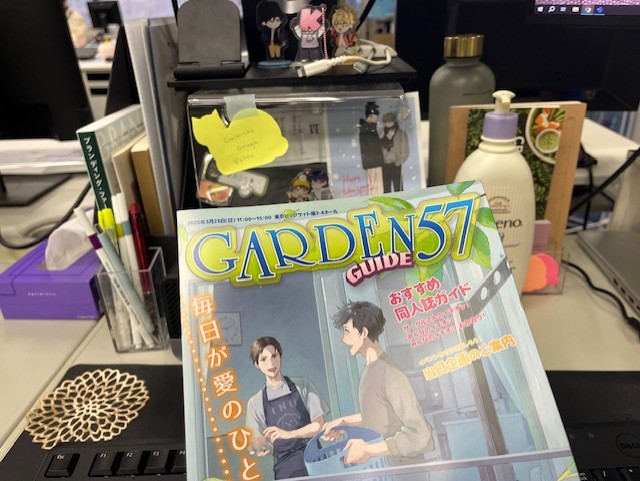
The Garden Guide came out on March 3rd, and I was careful to make a beeline to Toranona day-of. (I’m still traumatized from the J.GARDEN 54 Garden Guide running out early…) The most recent Guide cover is by といけ and features an adorable scene of domestic bliss between the illustrated couple—perfectly showcasing one of this event’s featured themes, domesticity!
Which brings me to some of the contents inside this spring’s Garden Guide! First, you have the special themes for J.GARDEN 57, which are domestic bliss (共同生活, kyoudou seikatsu), and childhood friends (幼なじみ, osananajimi)! Those are two really cute, fluffy special themes—perfect for spring! But J.GARDEN 58’s themes rebalance things: plain guys (平凡, heibon) and Merry Bad End (メリーバッドエンド).


Plain guys is pretty self-explanatory—guys who aren’t generally attractive but make up for whatever deficit is in their appearance by having something else about them that’s super endearing, or perhaps their partner thinks they’re cute even if the rest of the world doesn’t. Merry Bad End—or メリバ (meriba) for short—however, is the phrase for stories that are perhaps quite dark or weird or uncomfortable, but still has a ‘happy’ end for the characters involved, if even by their own extremely skewed standards.
Other things you can find in the Garden Guide include:
→ Flyers for other original doujinshi events, such as Comitia
→ Advertisements for BL publishers and their upcoming events
(Case in point, this one has an ad for upcoming KAIOHSHA events, such as their 22nd anniversary collab café and Momose An’s Naka Made Aishite pop-up shop and book signing. Yuzuriha… my love…)
→ An イチオシ section where creators and fans can showcase their faves
→ All participating artists listed alphabetically, by professional penname, or by table with their circle cut
→ A 出張編集部 showcase so attendees will know which publishers will be there seeking new talent or offering advice
→ Essays and interviews with other creatives or long-time participants in the space
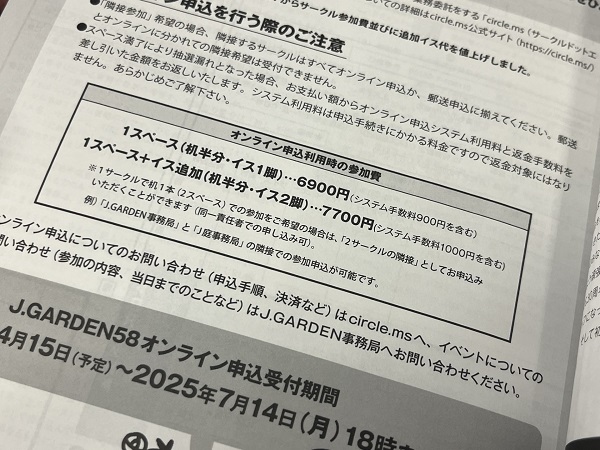
→ The application form for the next J.GARDEN (just 6900 yen—nice!—to table!)
→ …And, most importantly, your ticket voucher!
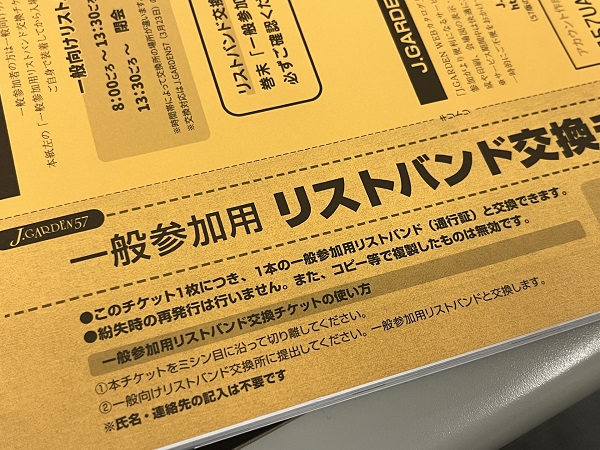
You can’t get into J.GARDEN without buying the pamphlet! (Unless they run out on the day of the event—only then will they just sell you the wristband!)
As for day of, J.GARDEN is often a bit more hush-hush than other doujinshi events, since it centers entirely around BL content, a significant chunk of which is pornographic. Other events tend to be loud the whole way into Tokyo Big Sight, with giant signs and staff waving excitedly and shouting directions to the crowd. With J.GARDEN, there’s a bit more intuition involved in just knowing which direction to go, and then you eventually start seeing more (small) signs about where to go and how to line up. My advice is “go left”—you go through the left-side doors when you enter the building, and go left at the conbini seating area. You can also just follow the crowd—if you see a bunch of women all heading the same direction, it’s probably safe to follow them!
As for the floorplan this year…
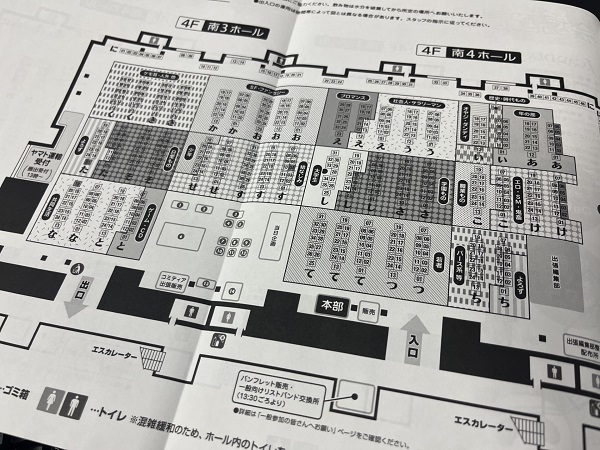
From top right to bottom left:
Age difference (年の差, nen no sa)
Historical (歴史・時代もの, rekishi・jidai mono)
Older men (オヤジ・ダンディ, oyaji・dandy)
Salarymen (社会人・サラリーマン, shakaijin・salaryman)
Bromance (ブロマンス)
Sci-fi・Fantasy (SF・ファンタジー)
Animal Ears・Beast etc. (ケモ耳・人外 他, kemomimi・Jingai hoka)
Hardcore (エロ・SM・鬼畜, ero・SM・kichiku)
Workplace romance (職業もの, shokugyou mono)
Schoolboys (学園もの, gakuen mono)
College Boys (大学生, daigakusei)
Childhood friends (幼なじみ, osananajimi)
Shota (少年, shounen)
Everyday Life (日常もの, nichijou mono)
Misc. (よろず, yorozu)
“Verse” etc. (バース系 等, verse-kei nado)
Young Men (若者, wakamono)
Project Space (当日企画, toujitsu kikaku)
Other media (ゲーム・CD)
Cohabitation (共同生活, kyoudou seikatsu)
These are just the (super simplified) descriptors for each section, but if you want to really understand what differentiates the themes in the different sections this area list Takochan found for me has some interesting descriptions on what the true difference is between サラリーマン and 職業もの. We had an entire discussion on the team about what the difference could possibly be, and were surprised at the descriptions.
Another important “day of” set of tips is regarding aisatsu. 挨拶 (greeting) is a really important part of the event process, both for original works AND for parody. It’s your opportunity to tell all your favorite artists and authors in attendance how much their work has impacted you, how many times you’ve read it, your favorite scenes, how their characters make you feel, etc. etc. It is incredibly important for creatives to hear positive feedback on their work (this is why we host Fanletter campaigns so you can share your love with your favorite artists!) and how it has impacted their fans!
As Sou also mentioned in their beginner’s guide to doujinshi events, however, be careful about WHEN you aisatsu an artist. If it’s just going to be a quick “I really love your work! Thank you for writing so many amazing stories!” it’s okay to do so while you purchase your book, but if you plan on giving them a letter or gift, or want to read a poem out loud about how wonderfully the artist draws hands, etc. please come back later once the initial buying rush is over. I know it’s tempting to kill two birds with one stone and aisatsu when you buy the book, but this can be stressful for both the artist, who’s going to look incredibly rude reminding someone of the long line when they’re just trying to compliment them and convey their love, and the other fans waiting in the super long line as the other books they want sell out one by one.
Two other things to keep in mind for aisatsu:
Pay attention to the badge! You might run into the 売り子 (uriko, or table helper) if there are multiple people at the table, or if the author has to run to the bathroom or go buy their own books—especially for popular or well-known artists. Newer artists might not know to differentiate between themselves and the uriko (or might not even have an uriko at all). If you run into a case where you’re unsure, you can ask the following:
● If there are multiple people at the table and you’re unsure which is the artist:
[author name]はどちら様ですか?
[author name] wa dochira-sama desu ka?
“Which of you is [author name]?
● If there’s one person at the table and you want to confirm they’re the artist:
[author name]でいらっしゃいますか?
[author name] de irasshaimasu ka?
“Are you [author name]?”
The other thing is 差し入れ (sashiire, or gifts)! If you plan to bring a gift, be sure to check if the author has an OK/NG list for which gifts they’re willing to accept. Some authors are more than happy to accept anything from their fans, but others are a bit more strict! For instance, some will not accept food—perhaps they’re on a diet, or have a food allergy. Others won’t accept skincare or beauty products—perhaps they have sensitive skin, and don’t want their fans to waste their money. To spare yourself and the author the sadness, discomfort, and embarrassment of having your gift rejected, be sure to check beforehand if they have a list of items they won’t accept. Fanletters are always going to be the safest bet, as some authors will only accept letters (though they’re always careful to note they appreciate the sentiment, even if they can’t accept anything else)!
Again, be sure to check out Sou’s Beginner’s Guide because it’s got lots of great info!
Make sure to keep your ID with birthdate handy as well, because it can really hold up the line when everyone is fumbling to take their ID out of their wallet when asked. If you know the book you want to buy is going to be R18, it’s good to have your ID on hand, even if you end up not being asked. I actually keep my ID on a lanyard around my neck for the entire event. I may look like a dork, but it’s very useful and a small kindness to the artists and other participants that I can quickly flash my ID and they can move on to the next person in line.
I think that’s it for now! I’ll leave you all with a handful of useful words/phrases that I wish I’d known when I attended my first doujinshi event and my Japanese was much worse:
新刊 – shinkan – new book/release
既刊 – kikan – previous book(s)
一冊 – issatsu – one copy
一冊ずつ – issatsu zutsu – one of each
新刊を一冊でお願いします
Shinkan wo issatsu de onegai shimasu
“I would like one copy of your new book please”
これとこれを一冊ずつでお願いします
Kore to kore wo issatsu zutsu de onegai shimasu
“I would like one copy each of this and this please”
※ this would be said while pointing at the books you want
Just remember: even if your Japanese isn’t that great or if you fumble with your words, just be polite, be friendly, use body language, and don’t stress too much! Everyone is there to have fun and share how much they love BL! As long as you’re also there to do that, you’re a member of the wonderful global BL community!

 rentaBLog
One thought on “J.GARDEN 57: Return to Paradise”