Beast Week Day 2: would you make these two your dogs?

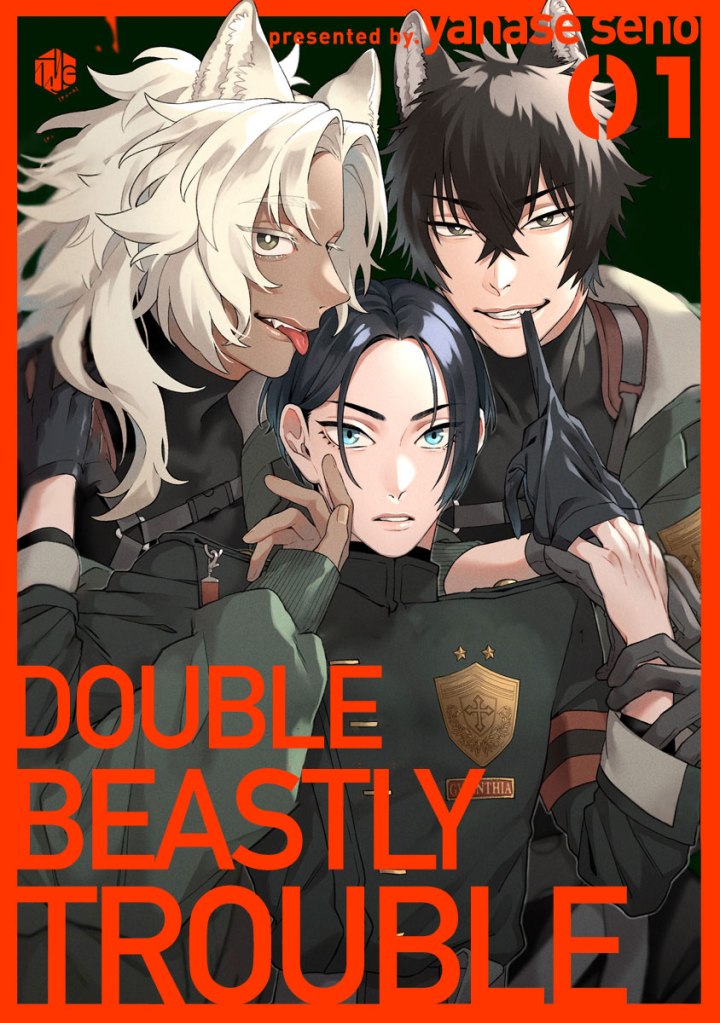
“Two (upcoming) beast-person manga reviews for Halloween?” Well, no, you see, the beast-people in Yanase Seno’s “Double Beastly Trouble” (Double Dog Buddy) are “beastly” (hah), sure, but they’re a species of their own, therefore they’re not the same as any other run of the mill wolfish beast-person. (Putting those rhetoric high-school classes to good use.)

Our protagonist, Sir Ewan Gwenthia, is an aloof, capable soldier, leading a squad against an underground dogfighting ring, where two members of a humanoid species, known as the “larga,” are being exploited. The two reigning champions, cool Zazie and dorky Seto, are unwilling to part with their turf, just as Ewan himself is loath to come anywhere close to a larga. As circumstances would have it though, the twain choose to follow Ewan as his ‘dogs’ and Ewan is obligated by the military to train and subdue them.

Many Renta! readers might be familiar with Yanase Seno’s gorgeous, crisp art-style from their other hit, “Geminis Craving Love” (Aisaretagari No Gemini), which means they might also be familiar with sensei’s apparent preference for 3P/poly action/ménage à trois. So far, the two larga that comprise this threesome are in agreement that they want to “toy” with Ewan. There’s more to them than their animal instinct for domination though, as, at times, they display a more nurturing side, too. With his small stature and very relatable thirst to prove himself, Ewan seems to bring that protectiveness out in the larga, just as much as their need to “play”.

Personally, I’m very keen to see where this plot is going. Ewan has character the depth of the Mariana Trench, and his unresolved family issues are a key part of the story. There’s also the intricate worldbuilding that doesn’t seem to be just there as a setting, but intrinsically connected to the characters, their background and hopefully their path forward. I’ll stop here before I end up spoiling anything, but, let’s just say, if you’re looking for a beast-flavored ménage BL for this Spooky Season, give Yanase Seno’s “Double Beastly Trouble” a spin. And, if you have read it, do tell, whom of the two larga do you prefer so far? (I’m team Zazie, btw.)

For more goodness:
Sensei’s works on Renta!
Sensei’s Twitter
Website
Instagram
Pixiv

Beast Week Day 1: There’s a Vampire in the School

Read here:
The Black Cat & the Vampire

Japanese title:
寄宿舎の黒猫は夜をしらない
Kishukusha no Kuroneko wa Yoru wo Shiranai

“If vampires have the power to charm people, that would fit him perfectly.”

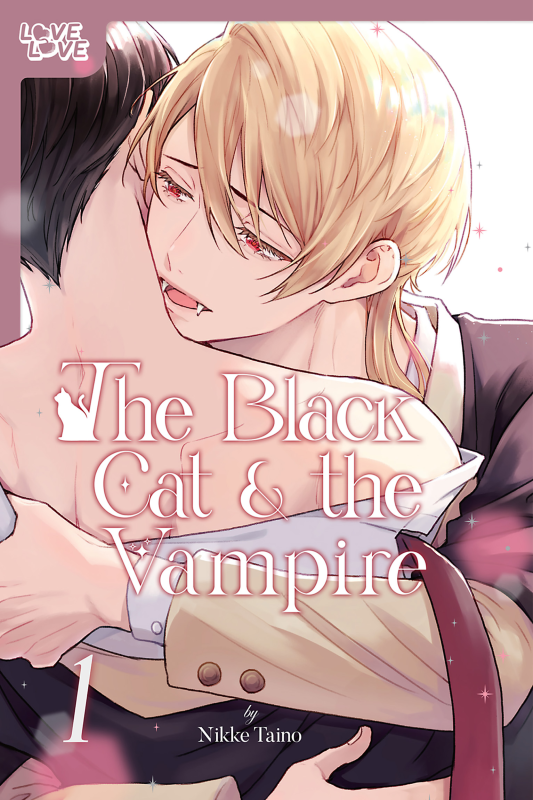
Set in a snowy fantasy boarding school in a nonexistent country, Nikke Taino’s “The Black Cat & The Vampire” sets the perfect eerie Halloween mood. Following honor student Yuki who just wants a quiet life of studying, there’s a mystery at the school when fellow student Aula wakes up dazed and weak, two bloody puncture wounds on his neck. Thus starts the rumor that surely there’s a monster on their secluded scenic campus—a vampire.

Almost instantly, Yuki starts to suspect the stunning and charismatic head boy Jean. “Vampires seduce people with their beautiful looks. And then latch onto their necks, so they say.” Vowing to get closer to Jean to find out the truth, Yuki feels himself drawn to the older boy, seeing a yearning and sadness in his flirtations. Jean says Yuki is the only one he can love and trust, specifically because Yuki doesn’t care for him. But what will happen if Yuki finds himself falling for Jean…?

Jean isn’t disgusted by garlic, nor does he avoid human food, and his teeth are as normal as anyone’s. But Yuki can’t shake the feeling that there’s some sort of supernatural allure to Jean. Strange things keep happening at their school and around Jean, but is Jean actually the culprit, or is he just another victim of circumstance?

I LOVE Nikke Taino’s work, and this is no exception. I live for the yearning and drama of Jean being madly in love with the only person who he desperately wants to never love him back. The characters are all so wonderful and have their own endearing personalities, and having such a wide cast of characters—as Nikke Taino generally does—makes the world feel so full and alive.

If you’re in the mood for a wonderful, fantastical winter mystery, I can’t recommend this enough. Is Jean really a vampire, or is he just an ethereally alluring man surrounded by misfortune? You, dear reader, just have to find out for yourself.

A foray into angsty omegaverse: Shima Yashiki’s “This Poor Beta Doesn’t Know About Love”

With the forces that decide which manga I get to check each month being out of my control (and fully in the hands of the team project coordinator), Shima Yashiki’s incredibly angsty and sexy “This Poor Beta Doesn’t Know About Love” (Awarena Betaha Koio Shiranai) appeared on my laptop screen at work quite unexpectedly.

Up until this story, I had never read omegaverse once (yet, after this, I also got to enjoy a certain fox-and-mouse romance), so this was a wholly new experience at that time. Obviously, as a twenty-something that spends most of her time online, I’m familiar with the concept, but not the nitty-gritty of it, you know? So, a couple of comprehensive guides later, I rolled up my sleeves and was ready to dive into this manga—to discover the perfect BL about fictional mind-games and emotional edging (maybe even the physical kind, too).

Continue reading “A foray into angsty omegaverse: Shima Yashiki’s “This Poor Beta Doesn’t Know About Love””

J.GARDEN: The Eden of BL

J.GARDEN didn’t start until 11AM, but the thing you learn fast with attending events is that you have to get there early. While the staff try to make it fair by holding lottos and raffles to randomize how and when people enter the venue regardless of when you actually show up, etc. you still get there early. There are more than 13 million people living in Tokyo, and even if just a small fraction of them care enough about original BL to want to attend J.GARDEN, you want to up the odds of getting in and getting the books you want as much as you humanly can.

There’s a reason many otaku refer to event days as “war”—you need to go in with a game plan, or you’re going to lose. And Sou and I were already at a rough start, because we’d missed the chance to pick up a pamphlet on pre-order. They’d sold out within the first four days of release, and we hadn’t been given the okay to attend until the fifth day. So we were kind of screwed. Nonetheless, we did what we could with what we had—which was Twitter’s #J庭54 hashtag, the official J.GARDEN site, and tons of passion for BL—and decided we’d torture ourselves getting up at 5AM day-of, come down early, get a pamphlet, and do our best to plan in the time between obtaining it and when doors opened.

Continue reading “J.GARDEN: The Eden of BL”

J.GARDEN: the importance of doujin events on the BL ecosystem

J.GARDEN was this past Sunday here in Tokyo, and our boss was kind enough to let us go as a work exploration!

What is J.GARDEN, you ask? Often shortened to J庭, or J-niwa—the Japanese word for garden, unsurprisingly—J.GARDEN is the twice-yearly original-only BL doujinshi event! It happens in the fall and spring, and has grown out of its original hall to house over 1000 tables. According to the J.GARDEN website, the event started in 1996 and has been going strong ever since, with this past Sunday’s being the 54th event, and the 55th already deep into the planning stages. (If you’re a long-time fan of BL manga and its deep lore, I highly recommend checking out all the past flyer and pamphlet art on the J.GARDEN history page. Truly stunning testament to the popular mangaka and art styles of the different time periods.)

J.GARDEN used to take place in the exhibition hall at Ikebukuro’s Sunshine City. For those who don’t know, Ikebukuro is a very important place to fujoshi, as it’s also the home of Otome Road. We hope to do a long-form explanation of Otome Road at some point, but until then, here‘s the Wikipedia article explaining it. The tl;dr is that there are many stores, restaurants, event halls, etc. in a very small stretch of Tokyo dedicated to female otaku, and is often seen as “Akihabara ~for her~” (though there are actually many male BL and otome fans who openly visit these places as well). In more recent years, however, J.GARDEN has been held exclusively at Tokyo Big Sight—an incredibly important otaku landmark some of you may know from tales of Comiket.

J.GARDEN is interesting because it’s a mix of old and new, big names and small fish, from all walks of life. There may be artists as huge and famous as Fumi Yoshinaga, but your favorite book purchased at the event may well be by someone you’ve never heard of before that you bought on a whim. It’s a chance for fans and creators to meet, and just be in a huge hall with others who sincerely love original BL.

While we plan on releasing a full report on our J.GARDEN experience later in the week, for now I interviewed a friend who has attended and participated in multiple J.GARDEN events and hopes to break into the original BL market. For those interested in the indie sector of BL, and what it’s like as a fan and a foreigner to make moves in the Japanese BL industry, please read on!

Continue reading “J.GARDEN: the importance of doujin events on the BL ecosystem”

The Butt-Smacking Rhythm Game That Has Me Clapping

Lovely readers of RentaBLog, have I got a treat for you today.

If you’ve been following the blog for a while (in which case, thank you!目がハート ), you may have come to expect BL manga reviews, informative culture articles, and overall insightful thoughts about BL as a genre — all hosted in one cozy spot.

Well, let me assure you, here at RentaBLog, we aim to post plenty of that, but we also strive to make this blog a safe space for…

DEGENERACY.

That’s right. It’s time to take off my “lover of all things fluffy and vanilla bean” hat for a minute so that I can talk to you all about a game that’s consumed my mind ever since I first learned of its existence… one that involves juicy ass, sexy music, and one very pretty mean boy.

Continue reading “The Butt-Smacking Rhythm Game That Has Me Clapping”

The Benefits and Drawbacks of Digital-Only Publishing

Good morning from Tokyo! I was originally planning on writing a review for this week, but the end of September has been a bit more hectic than expected, so instead I have a casual post about what it’s like to be a digital-only publisher, and the benefits and drawbacks therein.

When I was younger (like, late teens to early 20s) I must admit: I did not like digital publishing. I wanted a hard copy of all my books—and I mean all of them. When I still lived in the United States, I actually used to have the largest IKEA Kallax shelf—the one that’s five squares across and five high—situated in the middle of my room so I could use both sides, and I had the whole thing literally filled with books (mostly BL). Thousands and thousands of books. I hated the idea of digital manga because it felt like a ripoff. I wanted the physical book, in my hands, so I could do whatever I wished with it.

However, one thing you learn when you grow up and move—particularly overseas—is that you don’t want a lot of stuff. You can’t have a lot of stuff. It’s unfortunately just not possible to have so much stuff. Not only that, but apartments in Tokyo are incredibly small unless you’re unbelievably wealthy (or live inconveniently far from a station), so even if I could have afforded to bring all thousands of those BL back to Japan with me, I wouldn’t have the space for them.

Sadly, when I returned to the U.S. to clean out my childhood bedroom and decide what could and couldn’t come back to Japan with me, all but around 30 of those books had to be recycled. Soul-crushing, honestly.

So, needless to say, I had to make peace with the fact that I would be deciding between just not getting to read a lot of BL, having to read it and then sell it back (which is also a hassle, especially when you don’t have a car), or just… buying digitally, at which point I could have as many books as I wanted but also enough space left over in my apartment to eat meals, exercise, and play with my cat. And then I got a job at a digital publisher, and came to really understand that digital publishing for manga localization actually has a lot of benefits—though also, some clear drawbacks.

Continue reading “The Benefits and Drawbacks of Digital-Only Publishing”

Getting to the root of the problem in Ikuyasu’s “Boys, Love and Plants”

Twitter: @ikuyasu_elddrd

Read here:
Boys, Love and Plants

Japanese title:
愛玩男子ラブグロウアップ
Aigan Danshi Love Grow Up

Love is in bloom in over 200 pages of in-your-face beefy man action! The manga follows the many antics of Midori Sasaki, a young man running a greenery store. In addition to selling plants from his small shop, he also delivers to various offices. His business isn’t faring well (understandable, in this economy), so his side gig is offering special “escort services” to rich businessmen to supplement his income.

Things suddenly take an unexpected turn for Midori when his top client, an I.T. CEO named Eiichi Iwasaki, asks him to date his younger brother, Mizuki! Apparently, their parents are pressuring him to date, but none of those dates have been fruitful. Midori’s first encounter with Mizuki leaves much to be desired, with Mizuki insulting his job, life choices and lack of money, but still sleeps with him. Not to spoil too much but the more you read, the more gets revealed about their backgrounds, personalities and how money and social status has shaped each of their views on relationships and intimacy. While I felt like the two clashed like oil and water because of their differing views at first, seeing them eventually develop a close relationship and Ikuyasu’s gorgeous art made it a truly enjoyable story! Ikuyasu is very skilled at drawing buff men, and combined with the characters’ expressive faces, fluid poses, and steamy sex scenes, you are in for a real treat!

Part two follows Yuuma Shiroyama and his budding relationship with Eiichi from part one. Yuuma makes deliveries for his family’s boxed lunch shop. Though diligent and hard-working, his family is in dire straights due to his father’s medical bills. He catches Eiichi’s eye by chance when making a delivery to Eiichi’s office, who immediately accosts him for sex. To Eiichi’s surprise, Yuuma instantly agrees, and without spoiling too much, that initial encounter leads to a truckload of assumptions, misunderstandings and not the happiest of conclusions… at first! They do eventually end up as a couple, but it’s quite the hurdle for them both to overcome.

Another delightful part of this comic is all the little side stories included. Again, I don’t want to spoil the fun, but there’s a lot of six degrees of separation going on, and later you get to find out more about Yuuma’s and Eiichi’s families! Highly recommended if you like a mix of humor, drama, fluff and naughtiness! The characters are the true driving force behind this story and is a testament to how you shouldn’t judge a book by its cover. Midori seems like a money-hungry, morally grey sex addict, but he has a gentle streak, truly cares for the plants he sells, and struggles with forming meaningful relationships outside of sex. I thought Mizuki would be just another dime-a-dozen rich snob type, but despite his gruffness and extreme lack of tact, his love runs deep.

Eiichi struggles with balancing societal expectations as the eldest son of a prominent family and CEO of his own company, along with being naïve, as he’s lived his entire life never knowing what it’s like to have financial troubles. Yuuma, despite giving off strong innocent and shy vibes, is fiercely independent and stubborn. There are also a few allusions to flowers and plants in describing some of the characters, befitting of the title. I hope you’ll give this a read; it’s well worth your time!

Japanese for NERDS: Oshikatsu, Otakatsu, BLkatsu, and language

As you may have seen from my posts, I like to sprinkle in a lot of Japanese to help people learn and contextualize the language and culture a majority of our content comes from. While we’re a localization company, I know a lot of people who read manga do intend on eventually learning and hopefully mastering Japanese someday, whether it’s in order to not have to rely on English licenses to get that sweet, sweet content, or even just to be able to comfortably follow Japanese mangaka, publishers, or fan accounts, and it can be helpful to learn bit by bit through your hobbies.

Still in the process of my own Japanese-learning journey (I think most language learning never actually ends, honestly—even in your native language), after living in Japan for four and a half years I’ve found there are a lot of words that’re hard to know without specifically taking part in the cultures surrounding them. The same way, say, Dungeons & Dragons or Genshin or even sports fanbases have their own own vocabulary and phrases that don’t make a lot of sense outside their core community, being a nerd in Japan has its own language that can be a bit difficult to grasp for those not in the know.

A lot of these words take place within 推し活 (oshikatsu, a word that’s hard to translate but is essentially “oshi life”)—the words people use to talk about their favorite characters, idols, artists, etc. The word oshikatsu is a portmanteau (the Japanese language loves a good portmanteau) of 推し (oshi, or fav, bias, etc.) and 活動 (katsudou, activities), so essentially the activities and lifestyle of having an oshi. People who already take part in online or in-person Japanese otaku events likely already know this world well—the world otaku allow themselves to fall into once they’ve finished the dull slog of everyday life. The real world might suck, but at least we have oshikatsu to unwind to and enjoy with friends.

It’s actually such a common word at this point that it’s not rare to walk in to very average or trendy stores and see an oshikatsu section filled with colorful nui clothes, things to make uchiwa, or even just pouches and accessories in colors that are common signifiers of your fav idol or character. (For instance, my favorite character from Genshin is Xiao, so I tend to buy a lot of thing in the teals, greens, and soft purples that make up his color palette.) Trendy bakeries, cake shops, etc.—living an otaku lifestyle is very common and normal, and it’s not rare at all seeing stores and brands catering to it.

Nonetheless, there are still a lot of words that are so highly specific to actually living oshikatsu, otakatsu (“otaku life”), or BLkatsu (“BL life”) so I’ll introduce some of those words here. (Using Genshin characters and ships for many of my examples, since those are the names I know best lol.)

Continue reading “Japanese for NERDS: Oshikatsu, Otakatsu, BLkatsu, and language”

Awkward First Love: Jimi Fumikawa’s “I Seriously Can’t Believe You…”

Read on Renta!:
I Seriously Can’t Believe You…

Japanese Title:
君ってやつはこんなにも
Kimitte Yatsu wa Konnanimo

Twitter: @fumikawajimi
Publisher: @BPilz_Label
Link Tree: Jimi Fumikawa / B.Pilz

They say young love is the purest. I firmly believe it’s also the dumbest, silliest, and most awkward, and nothing captures that truly absurd “first love” feeling to me quite like Jimi Fumikawa’s I Seriously Can’t Believe You… with all its cuteness, cringe, and yearning.

The manga starts out with a ridiculous and innocent, but nonetheless cruel, joke that truly highlights how dumb and young these teenage boys are, with them not even considering the consequences of their actions until they’re already happening. Kon, our adorable main character, and his friends are wondering why the incredibly hot and popular Iida rejects every girl that confesses to him.

“Is he gay?”
“Wanna look into it?”
“What? How?”
“There’s only one way.”

Next thing Kon knows, he’s been suckered by his friends into confessing to Iida just to see how the other boy reacts. However, rather than accepting him—but still not offended or rude about it—Iida replies that he supports Kon’s inclination toward men but can’t return his feelings.

Continue reading “Awkward First Love: Jimi Fumikawa’s “I Seriously Can’t Believe You…””