
Read it on Renta!:
The Prefect’s Private Garden by Sanayuki Sato
Japanese Title:
プリフェクトの箱庭
Prefect no Hakoniwa
Links:
Sanayuki Sato’s pixiv
Professional Twitter
2nd Twitter
TW: yandere trope as a whole; emotional, physical and sexual abuse
In my endless rant about yandere BL, the manga that I gave the most love to was Sanayuki Sato’s “The Prefect’s Private Garden” which I can describe confidently as a masterclass in how to write yandere angsty romance. I’m biased, because the story includes a bunch of tropes I adore (TsukihitoTsukihitoTsukihi—), but, to borrow wise words from Sou, you know when you find a manga that hits just right?
Since “The Prefect’s Private Garden” was one of two works to hit that perfect spot for me (so far—looking at you, ongoing “The Monster & The Ghost” and “Double Beastly Trouble”), please join me on this rather long rant about a boy raised to see himself as a god that doesn’t understand love and a precious boy determined to fix that.
(Although I’ll try to keep them at a minimum, there will be spoilers…)

Enter Royston
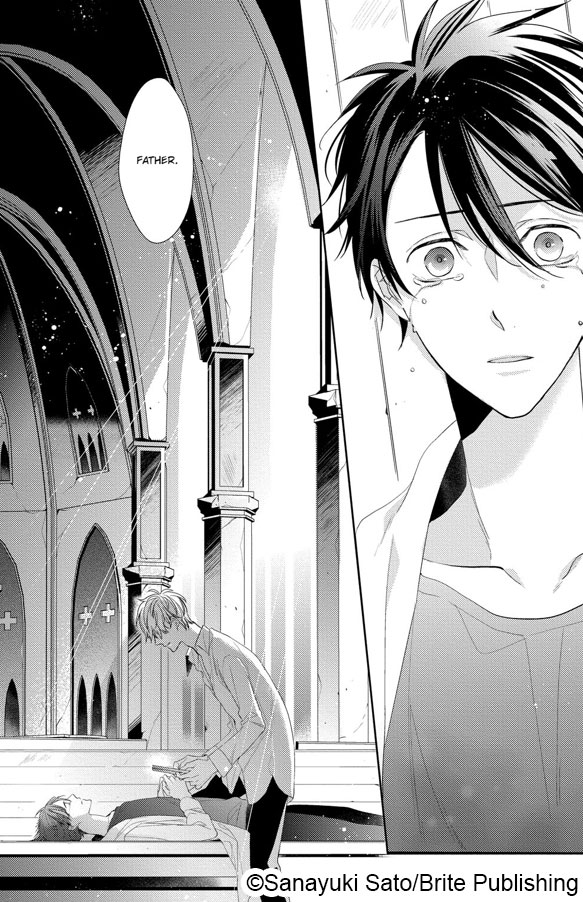
Mioto Sakura manages to enroll in Royston, a school for the elite (Eton, pretty much). The snobbish nobles around him aren’t so eager to accept a nouveau riche commoner amongst them, so Mioto’s welcome is nothing but non-stop bullying. He can’t opt out, forced there by his grandparents in exchange for information about his missing siblings. Save for two new friends, level-headed Kuze and daydreaming artist Suminaga, he finds himself all alone.
That is until his third night there, when a nightmare leads him to wander the school grounds into a chance encounter with a beautiful young man with fair hair and amethyst eyes. Misunderstanding why Mioto’s there, the older student thrusts him into a pew, Mioto tries to shove him away using the first thing he can find, and he freezes, recognizing the object in his hands as his father’s picture book, “On a Moonlit Night.” The strange man stops, too; it’s time for proper introductions. Turns out, he had always liked that book; he doesn’t mock Mioto for his fear of the dark, and, in this place full of contemptuous assholes, this person of otherworldly beauty looks like an angel.
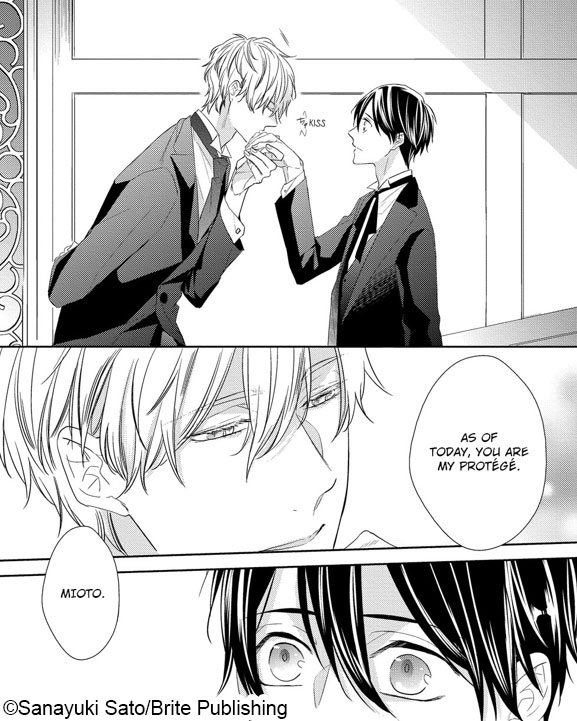
That is until the next day, when we find out that this angel is Tsukihito Touin, Royston’s Prefect, a.k.a. its absolute ruler and god. And, for some reason, this god decides to look favorably upon Mioto and make him his protégé—filling in a position considered sacred and sending everyone at school in a vengeful frenzy.
Fellow students out to get him, the forces that want to keep him away from Tsukihito, his missing siblings, and Tsukihito’s own increasingly unsettling demeanor—the perfect recipe for ANGST (and deliciously dubious fluff, later on).
The one to fill the eternal place
A common rule with protagonists is that they shouldn’t be moved by the plot, but the reverse—which you would imagine to be nigh impossible when our protagonist is rendered powerless from the get-go. And yet, Sanayuki Sato achieves the unachievable. While it’s not like Mioto goes on a campaign to change Royston’s unfair world (if anything, all he wanted at first was to lay low), he doesn’t accept anything without a fight—even from Tsukihito.
Mioto’s dad, Masato, cut ties with the Sakura family, denouncing their wealthy business to become a children’s book author and marry the woman he loved. But when they were killed in an accident, Mioto was adopted by his paternal grandparents, in the hope of turning him into the heir Masato never wanted to be—separating him from his siblings in the process.
Which is the plot-point that motivates Mioto and makes him a protagonist you want to root for. His grandparents won’t tell him anything about his siblings’ whereabouts, and finding out becomes his drive, so much so, that others will use it as a bargaining chip against him.
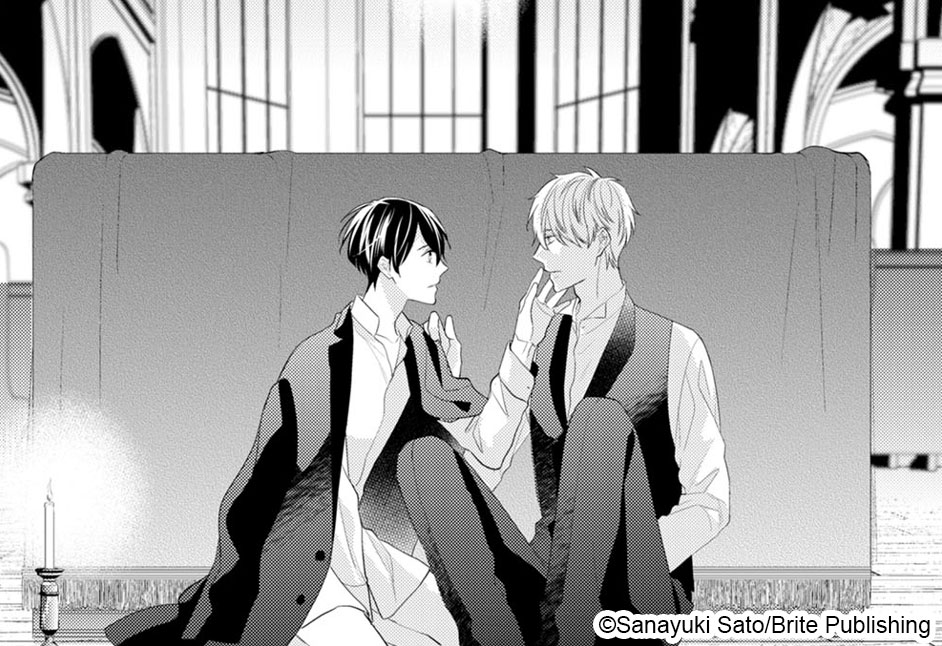
But, what about his relationship with Tsukihito, which is like that of a normal human trying to understand some kind of far-off divine being? How could he be strong there? That’s especially where his strength shines because Mioto refuses to bow down to him like a follower. Even when he knows that the repercussions of defying him could be dire, he never stops himself from taking necessary risks. And, once he recognizes his feelings for Tsukihito, he doesn’t just reach out to him, but he endeavors to help him, determined to save him from the irrational dark world he’d been trapped in as its “god”.
A benevolent and smiting god
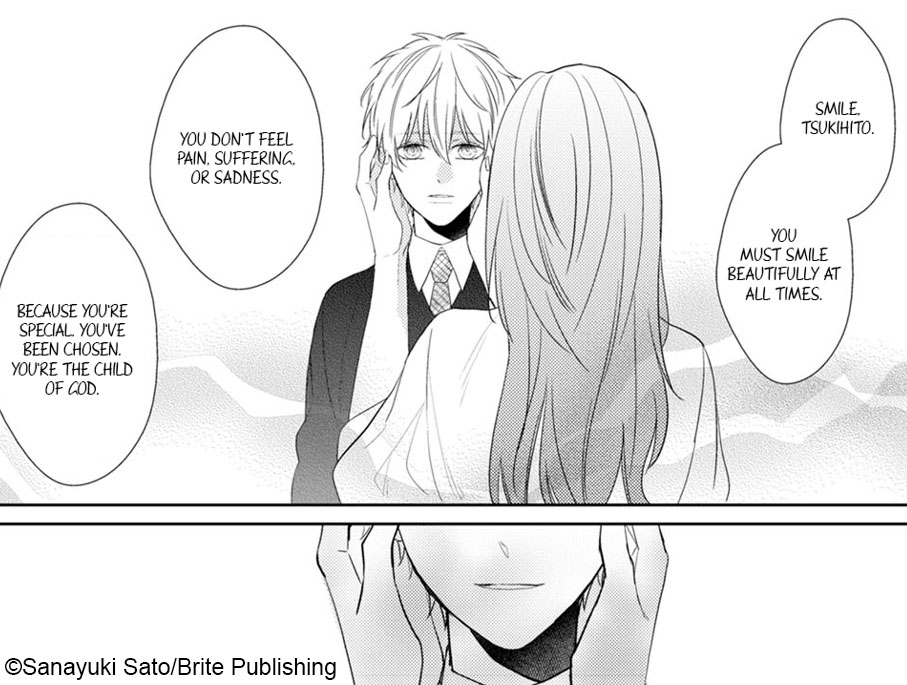
Tsukihito Touin is a prodigy, beautiful, perfection incarnate. A single smile from him would make everyone around him happy, much like the grace of a divine being. Receiving his ‘blessing’ is a ritual all Royston students crave to partake in. And, having been raised in an environment that worshipped him like that, Tsukihito comes to view himself as a god too.
But as his followers would say, “No one stands at Tsukihito’s side. No one is allowed to. He is alone. A perfect being above all others.” Which is why, when Mioto fills in “the eternal place” at his side, no one can understand why; they certainly can’t fathom that it’s because he was the only one who never expected that beautiful, bliss-inducing smile from him.
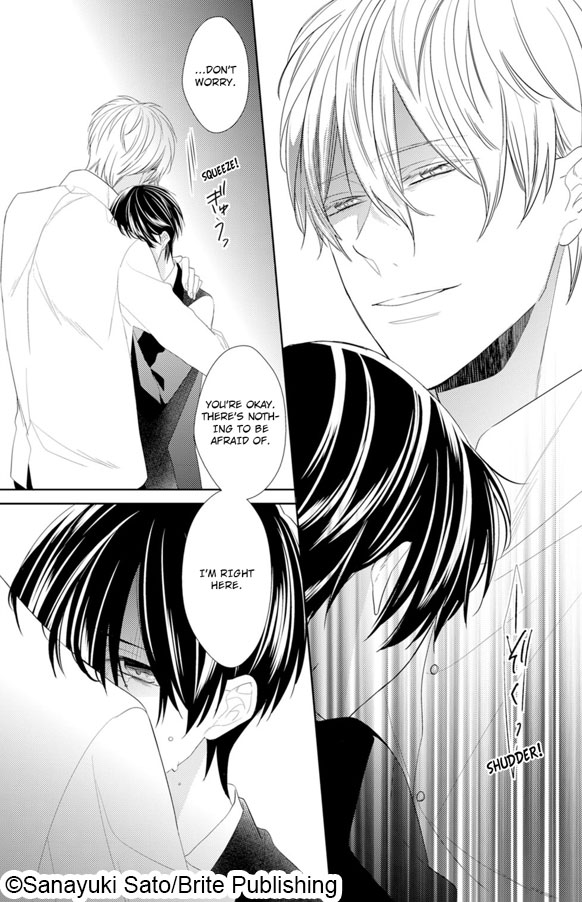
Just as Tsukihito becomes attached to Mioto, his true colors as this ‘heartless god’ start showing. He doesn’t care how much pain Mioto will go through just for being his protégé, so long as he can have him. He proceeds to use pinky promises as a method of restriction, with child-like simplicity and naivete in his intentions. He lets Mioto know that, despite the adoration he receives from everyone, he actually looks down on them all. Love, for Tsukihito, is synonymous with possession and control; he seems to treat Mioto like a pet rather than a fellow, equal human being—behavior that is no different to gods with incomprehensible motives, a unique worldview, vast distance between them and those on the ground—
But, Mioto is different.
The emotions that bubble up in Tsukihito when he sees him are strange; he, who’s always had anything he wanted and so many worshippers, suddenly finds himself coveting the one person that won’t give in to him. The feeling is new, and therefore irresistible, rousing him from the ennui he’s been steeped in since he was little. His heart had been stifled all his life, so he believed himself to be heartless. He had turned into this warped, cold thing, feigning smiles all his life, while viewing those who adored him as pathetic worms, far beneath him—but, being with Mioto, one who isn’t even afraid to show genuine anger (a feeling that Tsukihito himself wasn’t allowed to express, his emotions snuffed out of him), it nurtures his heart and, gradually, the real human under the frightening, godly façade starts to show.
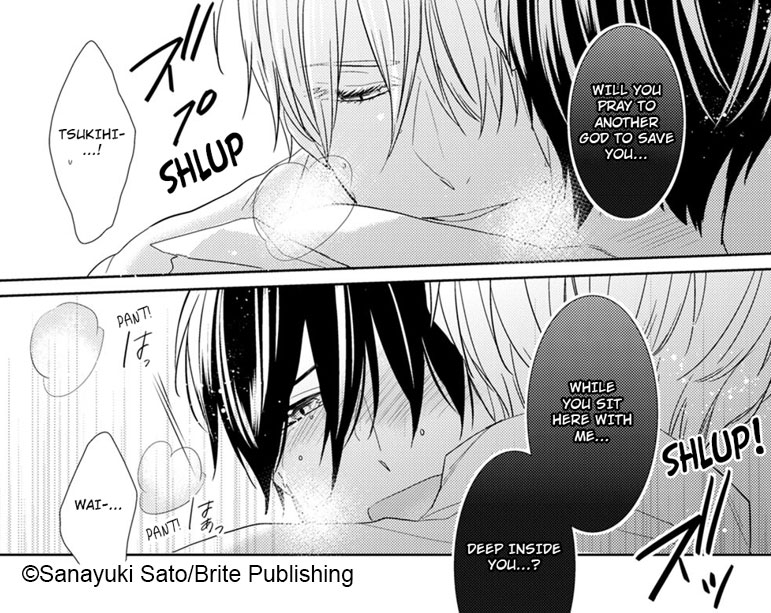
As Mioto pleads with him to learn to be human by his side, Tsukihito hangs on him and repeats his name the desperate relief of a parched castaway finding water. It’s the first time he’s found someone that treats him like a human, and he might be realizing just how much he had been longing for that. As Mioto articulates his boundaries resolutely, Tsukihito starts to navigate his newfound emotions and learn how to interact with the world soundly, how to manage his jealousy, how to hold back his possessive impulses, how to treat Mioto with trust and respect. Just as he gains self-awareness, he understands that he’s no benevolent god, but, even as a human, his heart has been indelibly stained and warped.
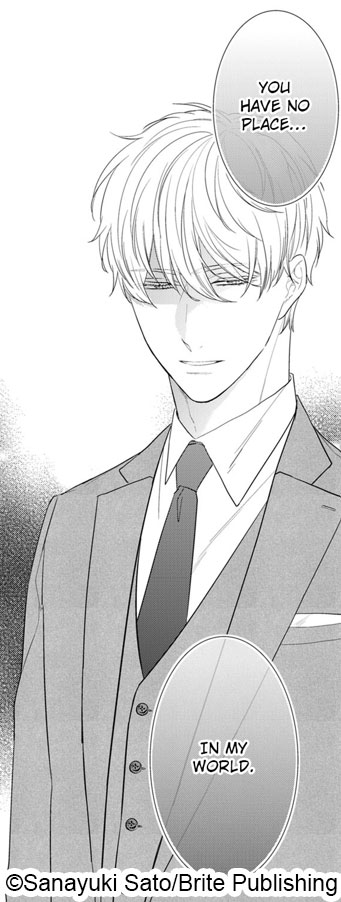
Eventually, those who created him and turned him into this thing, end up facing the consequences of their actions, like Victor Frankenstein encountering the Monster. When the god they had worshipped ends up judging them with callous, superior indifference, reality strikes. They weren’t prepared to deal with the real Tsukihito, a cold, ruthless being about to wipe them out, disgusted by them, as if they’re gum under his shoe.
He doesn’t need them in his world—he only needs Mioto. Even within his warped, god-like perception, his heart only has space for him. And Mioto, for his part, while holding him accountable to his actions, takes it upon himself to help Tsukihito out of his solitude, to teach him right from wrong, to make him human. And damnit, do I love this kind of dynamic in my fiction so, so much.
Yes, I’ll rant about the yandere trope again
In my yandere rant, not only did I show “The Prefect’s Private Garden” a lot of love, but I also attached it to a hella lot of categories; one could even say, the entirety of Royston is comprised of yandere characters, if you consider that the main trait of the trope is obsession.
But, on Tsukihito.
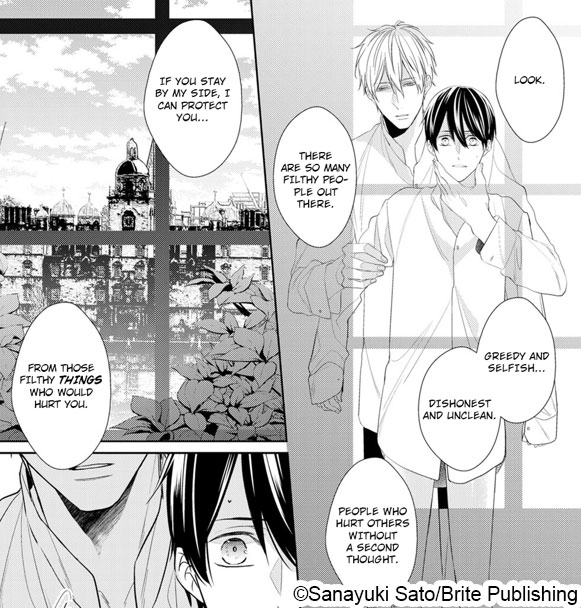
He fits right in with what I personally consider the ideal ‘yandere’. Love for the sake of love, love not for their victim, but for the idea of them in their head (after all, he became attached to Mioto so rapidly because he was already attached to the idea of him). An urgency to fulfill their need for possession, rather than respect the wishes of their loved one. Tsukihito doesn’t seem to be even hearing Mioto’s voice over his own affection for him. He derails Mioto’s path by locking him up and steering him away from finding his siblings; yandere, in their despair to satisfy their desires, tend to discard what matters to their victim—all they want is to consume their beloved entirely. He confines Mioto, all for the sake of “protecting him” from an ugly world, a form of “love” he learned from someone else.
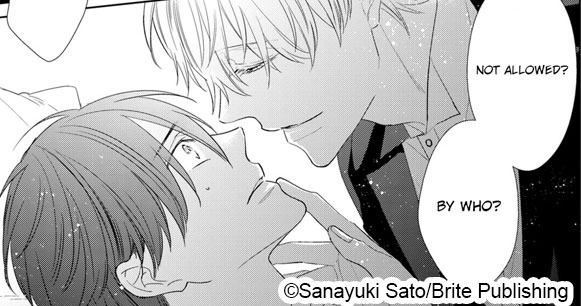
What I love so much about this story when it comes to handling the yandere trope is that Sanayuki Sato treats the perspectives of both parties with equal care, and both come out three-dimensional. Mioto’s hopelessness, after he’s isolated through Tsukihito’s sheer power alone, almost oozes through each page. Nobody in Royston liked him to begin with. But, the scary thing is, everyone would hand him over to Tsukihito in a heartbeat, without concern for his bruised state.
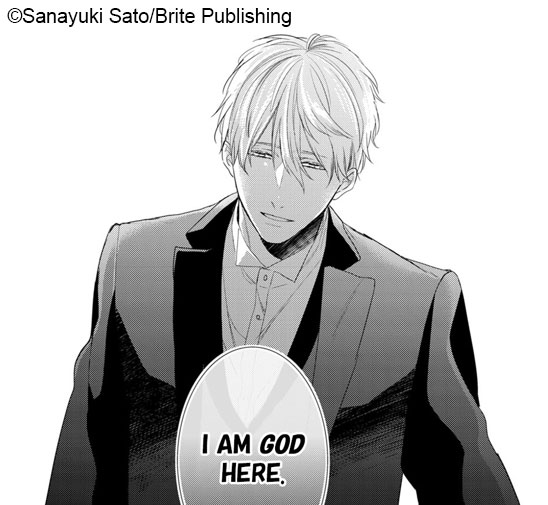
And then there’s our yandere’s POV. When they manage to meet in the middle and reconcile, it’s a gift topped with a bow, with both of them true to their characterization up until that point—Tsukihito proves that he’s not one of those tropey yandere that aren’t fully there; Mioto’s pain and anger reach him, he feels remorse for the first time in his life. There’s reason to his madness. And that’s why, while able to comprehend he fucked up, he also doesn’t just do a magical 180. He remains territorial and a scary, frigid being that only harbors fondness for Mioto and no one else. His need to keep Mioto to himself even surpasses his kindness; even as he’s trying to change, that change doesn’t contradict his character. He wants Mioto all to himself, but he also doesn’t want to hurt him. So, how does he find the balance between the two? What kind of emotional leaps does he need to make in order to compromise? Sanayuki Sato’s writing shines in showing his internal struggle.
UTILIZE YOUR SIDE CHARACTERS
While I’m a lukewarm defender of the two major 21st century book series that got lambasted for depicting horrible, dysfunctional relationships, one piece of criticism on that depiction that I do agree with is that neither series utilized their side characters effectively. It’s one thing to have your main character choose to be with a yandere of their own volition, it’s a whole other thing to have every other person around them be utterly blind to the yandere shenanigans and not try to intervene. And I don’t mean that in a love rival kind of way, as it was in those books, but in an “I’m a fellow human being that wants to look out for you” kind of way. As we perfectly see illustrated in “The Prefect’s Private Garden”.
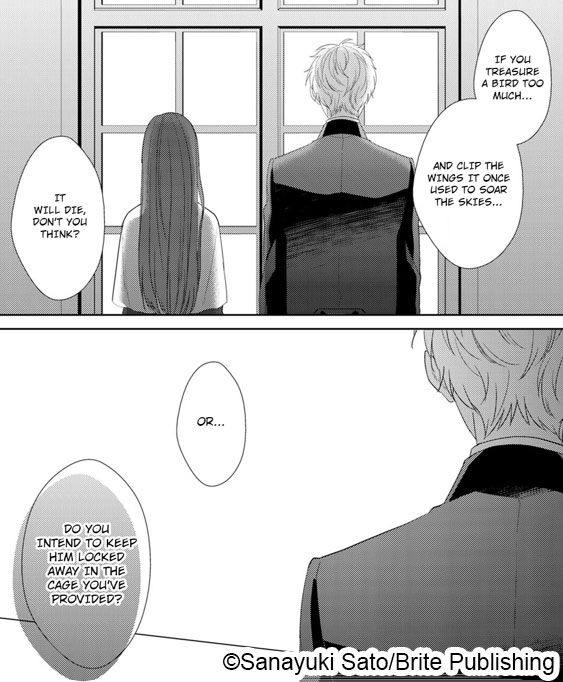
How do you guidethis messed-up couple forward in a way that makes sense for them to be together? How do you have Mioto help Tsukihito become human in a way that’s not an emotional burden on a young man that’s dealing with enough trauma of his own? And how do you portray Tsukihito’s growth as true to his character and not unrealistic, wishful thinking? When Sanayuki Sato has to deal with what might be the most difficult bridge to cross for any angst-romance writer, they bring on the side characters.
We’ve got Kuze giving Tsukihito the stink-eye, or interfering to protect Mioto, fearless of Tsukihito’s authority; we get Hanabishi acting as a guardian angel from the start ( the prophet we needed but didn’t deserve); others get the creeps just by a mere glance at our yandere; and even hostile characters notice Tsukihito’s possessiveness and point out just how dangerous he is. Through his interactions with others, we even see his palpable change. Letting your side-characters barge into a romantic relationship is the best way to “show, don’t tell”.
Art to get your feels soaring
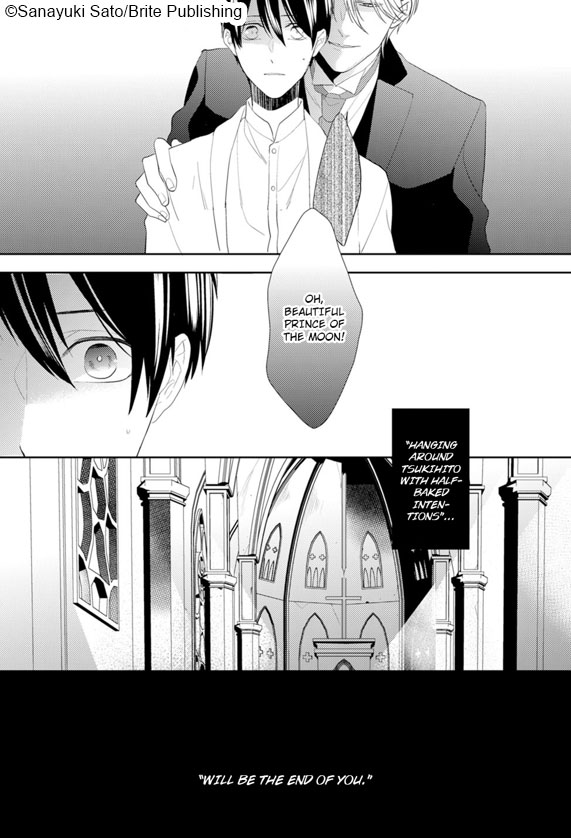
And of course, I cannot not talk about Sanayuki Sato’s art, in particular their brilliant directing style and panel composition.
What jumped at me on my second read is the inconspicuous hinting at later developments, right from chapter 2 or so. Characters appear with uncanny timing, the “camera” emphasizes details that will become important later on… Seriously, go back to the first few chapters after you’ve read it all once.
There are certain scenes that are simply breathtaking, such as one in the art room, where Mioto is surrounded by canvases, the sheets covering them billowing in a foreboding breeze. There’s a reunion that has incredible pacing throughout. And the romantic or intimate scenes between our two main characters deliver the right emotions every time—from fear and control to genuine love and care.
Bonus points: the ability to express the otherworldly quality of Tsukihito’s countenance. Just by his blank yet at the same time cruel expression, you get jitters sometimes. To borrow a quote in a light novel about my favorite character ever, “his eyes seemed to see humans only as those that will die at some point and those that must die right now.” That’s exactly the effect Sato achieves anytime Tsukihito gives someone The Look.
🖤🖤🖤🖤🖤🖤
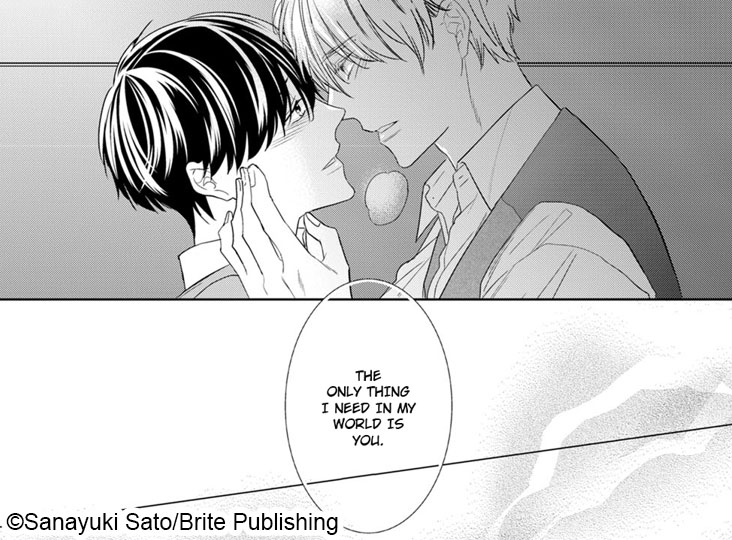
And that’s enough ranting for the day. I’m absolutely obsessed with “The Prefect’s Private Garden” (as much as Tsukihito’s obsessed with Mioto?), so much so that Ames and Sou might’ve had just enough of it, eheheh… And, good news for any fellow fans, the final chapter might have just dropped into my lap and will be getting ready to be checked and uploaded on Renta! soon!!! Until the story’s full conclusion, please share your manga obsessions in the comments, and remember to drink your water.💧

 rentaBLog
One thought on “The moon won’t let you feel lonely: a deeper look into Sanayuki Sato’s “The Prefect’s Private Garden””