
Read on Renta!:
My Perilous Darling Boy
by Akota
Japanese:
Gakeppuchino Darling Boy
崖っぷちのDarling Boy
Links:
Akota’s Twitter
Akota’s Instagram
The very first of anything is something to remember—which is why I remember that the very first BL I got to check after joining Renta! was a short rollercoaster of a story, Akota’s “My Perilous Darling Boy”. My trainer back then probably couldn’t have asked for a better vehicle for getting all our style-guide rules into my head: Akota’s stunning art is packed with details, which means that there could easily be mistakes in replacing sound effects; speaking of sound effects, there were many, so you could miss or mistranslate some; and the translation itself, in a story this subtly complex sometimes, was another challenge altogether.
But we’re not here to talk about translation/checking woes, we’re here because I wanna tell you that, aside from the fondness I have for this manga for being my first BL task, I do genuinely love it.
There are too many BL about Japan’s legendary host clubs to count, but this one earned its stripes, in my opinion, by humanizing not only the hosts but also their clients.
For the uninitiated, though—what is a host club?
Host clubs are a field of the entertainment industry that concerns bars where clients can sit in the company of handsome men, hold pleasant conversation during which all their needs for communication are met, and drink—and drink, and drink, and drink, because the club makes money from how much alcohol they sell, and the hosts will encourage you to buy more to get their own commission up. A common misunderstanding is that host clubs are part of the sex industry; and, while that’s not 100% wrong (after all, some hosts might provide “after hour” services, if you catch my drift *wink wink*) it’s not fully right either. After all, sex is not really part of the official job per se, and it’s much more apt to liken a host to any kind of entertainer. So, while a walk around Shinjuku’s famous Kabukicho could land you in a genuine sex-work establishment, host clubs aren’t—necessarily—part of that.
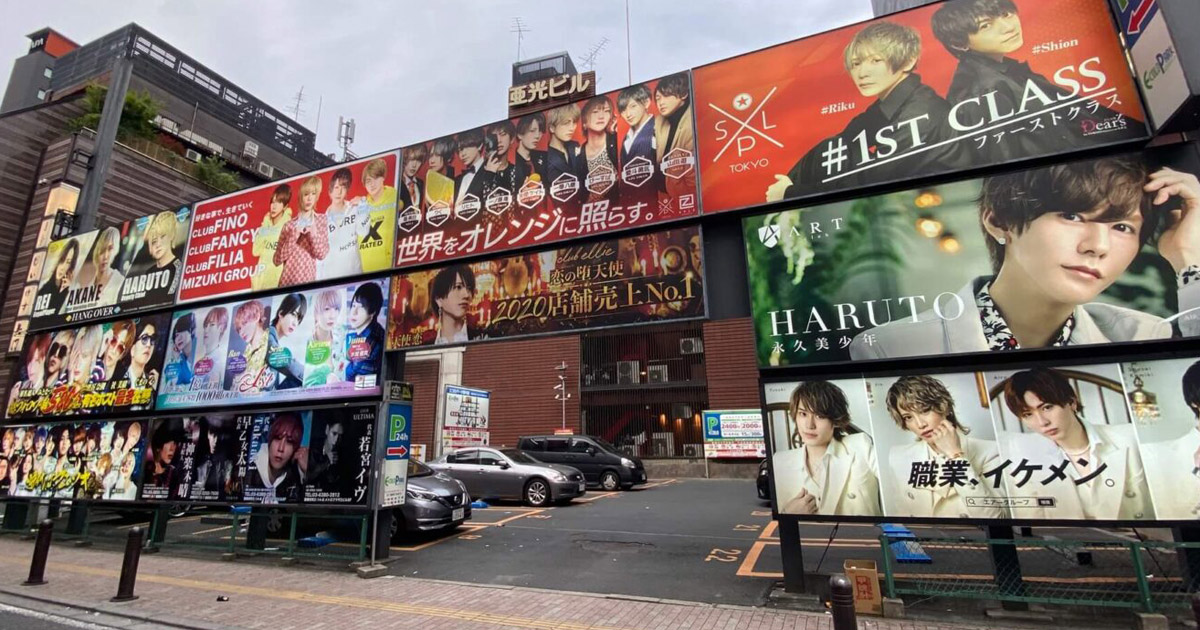
Another thing to keep in mind is the dreaded, aforementioned commissions—the host world is a cutthroat one. Hosts are in constant competition with each other within the same club and rival businesses, and being no.1 is an important feat for them, both for the money and the prestige—and this is the world in which “My Perilous Darling Boy” takes place.
Kanata is an arrogant, self-absorbed host that’s enjoyed top popularity up until Iori shows up—while new in a game, Iori manages to woo their female clientele without breaking a sweat and Kanata can’t stand the humiliation of watching all the women that once liked him now fawn over Iori…
That’s when he finds out that any fellow hosts worried about their sales numbers have been going to Iori’s place for private lessons on lady-wooing and conversation tactics. But, just as Kanata decides to swallow his pride and head over there to get his help, Iori reveals that the training regimen for Kanata to understand a woman’s heart, must include sex, with him as the bottom.
Has everybody else agreed to this? Will that really help his sales, like the others? How?—well, it doesn’t matter, so long as he rises back to the top, and Kanata begrudgingly accepts.
Feelings, of course, get thrown in the mix, everything becomes complicated, a web of lies starts making itself known—but where “My Perilous Darling Boy” excels, in my humble and honest opinion, is, again, in humanizing both sides of the business deal involved here.
It’s a known secret that hosts provide a service that’s intrinsically parasocial. A lot of clients are unable to differentiate between business and private life; even if they do, they seek to push that boundary; or, they become hooked on the fix of an alluring man lavishing them with attention, so they go broke or involved in shady business just to be able to pay for those darn champagne bottles that are keeping them and their beloved host apart.

A one-sided “loving” relationship that’s dependent only on how much money you pay must be bad for the heart long-term; and a lot of criticism for the host business is thrown at the hosts for taking advantage of peoples’ emotions for monetary gain. However, it’s exactly the lack of something vital in the heart, like the need to feel special to someone for at least a limited amount of time, that drives people to frequently seek some Tender Love and Care in the glitz and glamor of host clubs.
And, here comes Iori, pointing out to Kanata exactly just how subtle and sensitive this topic is. Kanata views his female clients as nothing more than easy conquests, a stepladder to the rank of No.1. With an ego the size of the Montana great plains, he talks and talks about himself, doesn’t pay attention to the girls dependent on him for a listening ear or a shoulder to cry on, and treats them as walking wallets to throw money and adoration at him—which is exactly why he lost the plot, since the crucial skill any host must have is the ability to listen, the ability to make their clients feel important, the ability to care for people.
Iori shows that you must treat people as human beings, even in a business model that’s made to suck their money—and the story truly emphasizes the precarious tightrope hosts need to tread. Don’t make boundaries clear to your clients, and you risk getting a stalker; ruin their fantasy, and you risk being unpopular; become self-absorbed due to all the adulation, and you risk it all crumbling under your feet.
Kanata is able to understand this only after Iori puts him on the receiving end of this host-client business deal—it sure hurts to fall in love with someone that might ultimately never love you back, huh, my dude? Or, it sure hurts to feel used and tossed aside, HUH, MY DUDE???
Still, as angsty as this story can get, hurt/comfort fluffy goodness lies at its core, I promise. And, the art is the perfect vehicle for the story, with a 90s visual kei aesthetic to it almost that captures the pizazz of Kabukicho and the host world perfectly—as well as the story’s ero, mm-mm. Bonus points go to the delicate lineart that just makes everyone look otherworldly, especially combined with the soft shading that’s just right every time.
But that’s enough ranting from me. Do leave a comment if you plan to read the story—or, if you already have, what touched you the most? Did you see the twist in the end coming? What did you think of it? Are you Team Iori or Team Kanata? Any and all tho(ugh)ts are welcome!😘

 rentaBLog