Make sure to cast your vote! ChillChill Awards 2025 nominees dropped this last Friday, and boy is the competition intense. Around this time last year I wrote about the ChillChill BL Awards and why they matter so much—about ChillChill’s rise from a review and indexing site into essentially the community hub for all lovers of BL manga in Japan—so I’ll spare you from having me write too much here. Nonetheless, I still wanted to make a quick index of all the nominees from the 2025 BL Awards that you can read on Renta!
Last year we had quite a few, and thankfully this year is no different. Also, not just in regards to Renta!, this year’s BL Awards are a testament to how big BL is getting in the West because many of the nominees are licensed by a variety of other localization companies—both digital and print. It’s so wonderful to see how many BL get brought to an international audience now, not to mention so fast. It used to take much longer before BL was licensed for release in the West, and the options used to be so few and far between. It’s such a testament to Western BL fans who keep showing up pushing that BL isn’t just some niche genre—it’s got a massive and excited fanbase ready and willing to support the genre and its creators in any way they can. I love that so much, both as a fan and obviously as someone who works in the field. I can work my dream job only because of the BL fans who show up to support its creation. Thank you so much!
Another thing that’s a bit of a pride point for me is that two years in a row, now, most of our associated BL Awards nominees (particularly our own licenses and localizations) are in the up-and-coming category. That’s honestly so exciting! I talked a little bit in my post about the benefits and drawbacks of being a digital licensor about how we’re able to take more risks on lesser-known, up-and-coming talent due to the lower entry fees of digital versus print, and it fires me up every time I think I get to play even a tiny part in bringing these new artists to a wider audience. And this year’s BL Awards have a particularly good mix of super popular, established artists and rising stars!
Anyway, without further ado, here’s the list of the 2025 ChillChill BL Awards titles you can find on Renta!—including some sneak peaks into exciting upcoming licenses! 🤭
If you follow a lot of BL artists and publishers, there’s a good chance you’ve been seeing the #BLキャラ総選挙2024 hashtag floating around Twitter over the last couple weeks, along with little profiles of BL characters belonging to the artist or publisher. When I first started seeing them about a week and a half ago, I initially assumed it was just a fun new Twitter trend among mangaka, but boy was I wrong (and also super behind on commercial BL news—I guess you can really tell the Renta! office has been super busy these last couple months).
BLキャラ総選挙2024, or the “2024 BL Character General Election,” is another effort by the wonderful BL site ChillChill to spread the love for commercial BL. It was initially announced in early May with the following blurb (loosely translated by yours truly):
For the amazing commercial BL characters who make you feel all warm and fuzzy inside!
This BL election was brought forth in order to shine a spotlight on those wonderful BL characters, spread the love of the BL series they’re from, and introduce new stories to an even wider audience!
This is really interesting, since the ChillChill BL Awards already used to have a seme/uke character section. So in this BLog post I’ll give a brief rundown of the ChillChill BL Awards character ranking history, before showcasing the BL characters whose stories you can read on Renta!, how to vote, and a little chatter about some of my personal Best Boys.
To delve deeper into the history and evolution of BL, the Kadokawa Culture Museum in Saitama is hosting a well-curated exhibition, titled, “BL Evolution: From Pioneers to Global Phenomenon ―Tracing the 50 Year History and Impact of Boys’ Love through Manga, Literature, and Media”. Sou and I decided to brave the one-hour train ride from the Renta! office, to give you a detailed report on what’s up.
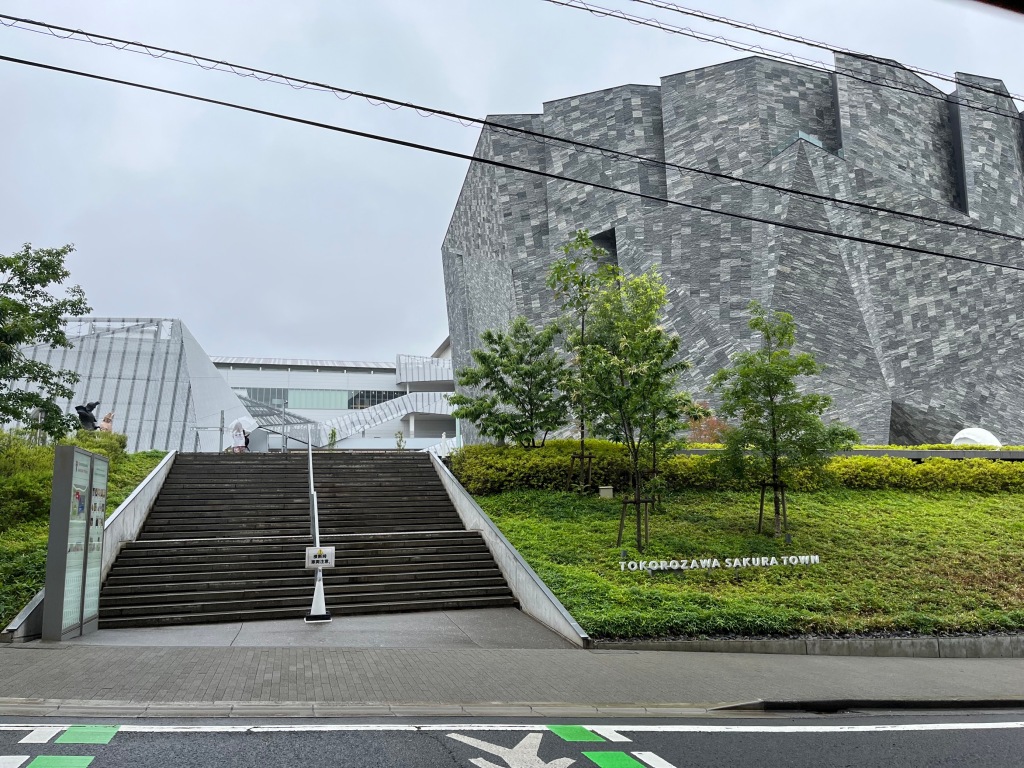
The museum, established by the publisher Kadokawa, permanently hosts the Manga and Light Novel Library on its first floor, as well as the impressive Bookshelf Theater on the fourth. Rainy day be damned, the modern shrine on the museum grounds was also worth a visit, especially to get a good-luck charm for keeping deadlines (surely, an invaluable must-have for every mangaka).
The exhibition divides the evolution of BL as a genre into three eras. Numbered hearts with arrows piercing through them point visitors each step of the route, and famous voice actor Toshiyuki Morikawa narrates parts of it in his mellifluous voice.
First comes the ‘June’ era. ‘June’ was a women’s magazine founded in 1978, which focused on stories of male-male romance. It fostered many BL authors who basically pioneered the depiction of homosexual love in manga, preceded in literature by the books of Mari Mori. A timeline of BL publications, anime productions, visual novels, drama CDs, etc. adorns a huge wall, tracing the long history of BL. Across from it, a glass case protects old ‘June’ magazines with covers by BL trailblazer Keiko Takemiya, manuscripts, drama CDs, and even albums by David Bowie or books by Herman Hesse, as a collection of not only artifacts from the history of BL, but also of the manifold media that influenced the genre in its infancy.
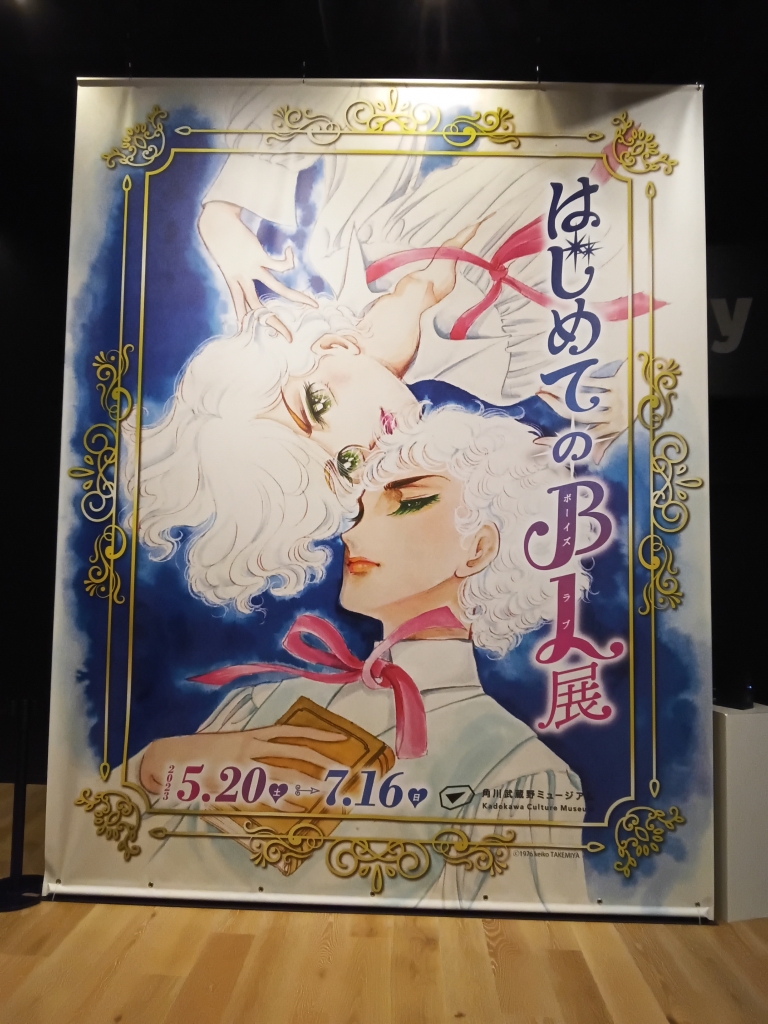
Speaking of the great Takemiya-sensei, her gorgeous art serves as the exhibition’s key visual. The exhibition also displays parts of her project Genga’(Dash), which is dedicated to the reproduction of original manga manuscripts. It is led by her, in collaboration with the International Manga Research Center of Kyoto Seika University and the Kyoto International Manga Museum (worth a visit, by the way!). Not gonna lie, seeing manuscripts from the ‘70s, reinvigorated in such a way, made my manga-loving heart giddy right off the bat.
And we were only starting. The exhibition then explains the ‘Yaoi era’. Most BL fans might already be aware, but a refresher never hurts: ‘yaoi’ is an acronym for the phrase “Yama nashi, Ochi nashi, Imi nashi”, a.k.a. “no climax, no punch line, no meaning”. Essentially, it came to refer to manga fanfics (doujinshi), created just for the pleasure of creating itself, without a care for plot, development, art quality, and so on. The first usage of the term is said to be in a doujinshi published in 1979, followed then by the ‘yaoi boom’ of the later 1980s, characterized by the birth of “coupling”/”shipping” of male characters in major shonen manga. Apparently, the first manga to facilitate such a rise in shipping doujinshi was Captain Tsubasa, which the exhibition highlights through maps of Comiket throughout the years (Comic Market = Japan’s biggest convention which caters to doujinshi artists and fans alike), increasingly more and more overcome by Captain Tsubasa doujin artists. This section included everything that I love: a culture of independent artists creating for the fun of it, and shonen manga. Couldn’t ask for much more.
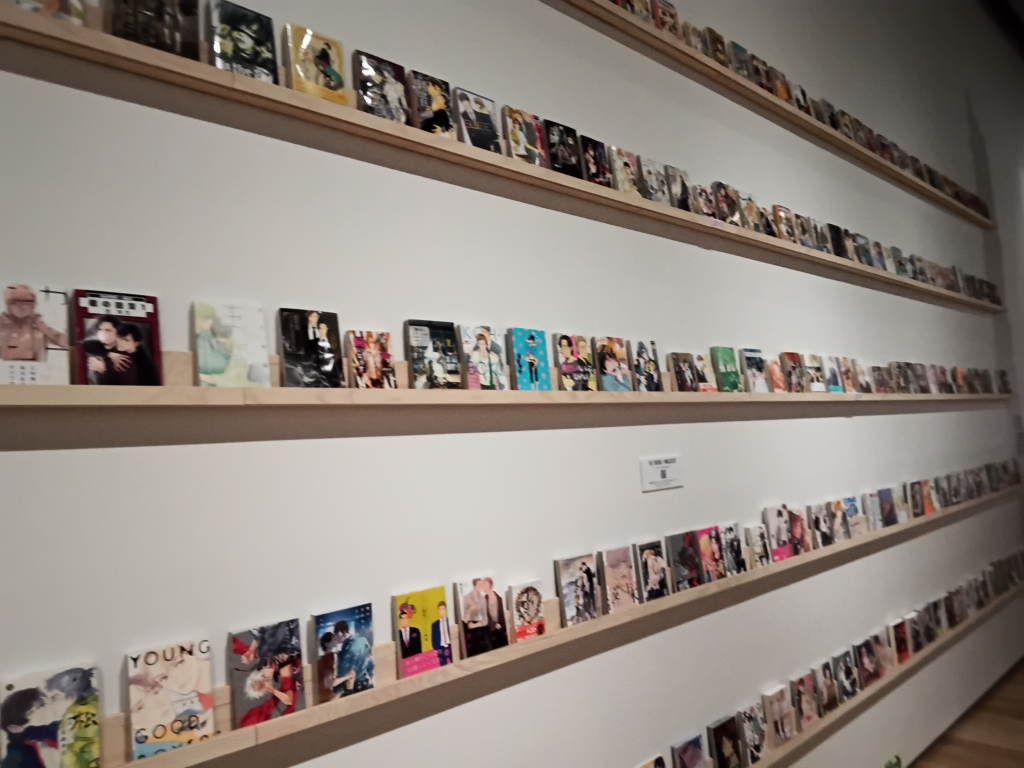
Subsequently, as yaoi culture expanded from Japan to the rest of the world, so did BL culture as a whole. That’s what the third and last section, ‘Blooming BL culture’ focuses on. From the early 1990s, BL manga and novel magazines were launched one after another, Kadokawa established its Ruby Bunko label for aesthetic BL novels, and more and more authors active in both BL and non-BL works made their debut. The exhibition also features examples of just how far broad the reach of BL has become, expanding into a transmedia franchise that’s recognized and followed by people all over the world (otherwise, Renta! and this blog wouldn’t exist!). In this finishing part of the exhibition, there are even posters and trailers of the movie adaptation of the manga “BL Metamorphosis”, about a young girl and old woman forging an unlikely friendship through their shared appreciation for BL. There’s also a huge wall displaying various BL (such as Tamekou-sensei’s ‘Lala’s Married Life’, Nagisa-sensei’s Kabukicho Bad Trip, Sorai-sensei’s Our Not-So-Lonely Planet Travel Guide), in a display of just how big and diverse the genre has evolved to be!
For anyone interested in visiting the exhibition, it’s on from May 20th to July 16th at the Kadokawa Culture Museum, in Saitama. The nearest station is Higashitokorozawa, accessible through the Musashino line. It’s definitely worth the train ride, even through the early June rain!


 rentaBLog