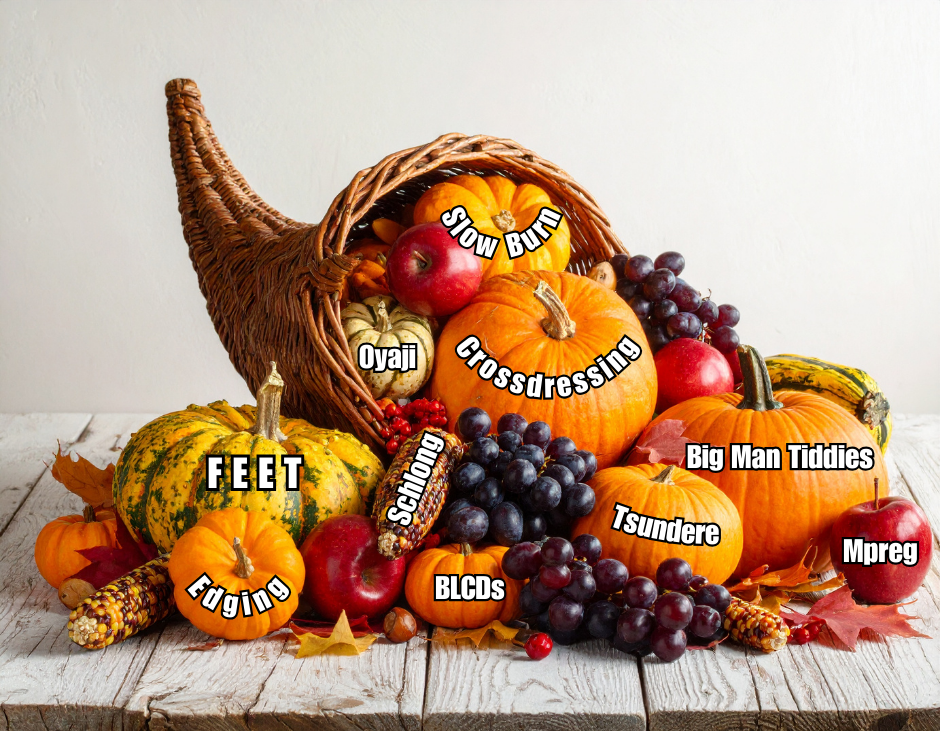
What We’re Thankful For This Year

It’s never a bad time to take a moment and appreciate all that yaoi has given us…

It’s that time of year again — at least for the folks who celebrate Thanksgiving 🦃 — where we fill our bellies with all kinds of festive delights, spend just enough time with family for some sort of decades-brewing drama to surface, and promptly retreat to a secluded space to continue reading that BL you’ve been meaning to get around to.

Sou after Thanksgiving dinner, or after a large serving of big tiddy BL

Whether it be personal relationships or developments in the world at large, there’s never a shortage of sources of stress and despair. Luckily, I’ve found that BL is a reliable mood lifter in both the good times and bad — it’s just the thing I need to make me go, “Maybe this Chungus life isn’t so bad after all.” (Well, that and pumpkin pie piled high with Cool Whip, but sadly neither of those things are exactly common in our corner of Japan.)

When I proposed this post theme to my fellow BLog members, they asked whether “things to give thanks for in the BL sphere” meant BL tropes, changes in trends, specific BL series or characters, or recent BL news. I decided not to limit the theme so as to release as much BL gratitude from the depths of our hearts as possible — so get ready for our unfiltered gracious yaoi ramblings.

Continue reading “What We’re Thankful For This Year”

Doujin Digest: Irodori Comics & Publishing “Doujinshi”

In 2024, we had the honor of partnering with Irodori Comics, a company with the intention of connecting doujinshi fans around the world with Japanese creators. Since most localization companies work directly with publishers rather than artists, doujin works—particularly BL ones—were previously slipping by under the radar. Thankfully, Irodori is here to fill that gap!

So, you might be asking, what exactly is the difference between publishing licensed manga and doujinshi? Well, first we have to discuss what doujinshi is. In much of the west, the word “doujinshi” probably conjures up one of two things (if not both at the same time): porn and fanworks. In reality, doujinshi doesn’t have to be either of these things. It essentially means “similar interest booklet” and it’s most similar to the concept of a zine—a small, inexpensive, self-published book or pamphlet meant to share personal interests and opinions with like-minded people.

So essentially, doujinshi are just self-published books. Most commonly, doujinshi are comics or novels. But you can also have “doujin goods”—goods made by and for fans on a small, inexpensive scale. Doujinshi are best used as a space for creatives to share their ideas and stories and artwork with like-minded people without requiring approval and support from a publisher.

Publishing doujinshi and participating in events is also a wonderful way for newer artists to get their name out there if they aspire to a career in illustration, or as a writer or mangaka. In fact, many well-known published BL mangaka started out in doujinshi circles, often getting popular through their derivative works. But publishing doujinshi isn’t just for beginners awaiting their big-time debut—no, if you’ve read our J.GARDEN event reports, you’ll know some of the most famous mangaka still release new doujinshi and attend regularly, which is a testament to what an important part of the manga community and ecosystem these events are.

So, now that you know what doujinshi are and why they exists, what makes them so difficult to license overseas? For parody works, that should be obvious: no one is supposed to be profiting off derivative works (which is the only reason they’re allowed to exist in the first place—generally, fanwork creators in Japan price their works so the prices are just enough to cover the necessary expenses for production and/or printing). But why do so few companies release original doujinshi?

As I noted earlier, most localization companies work with publishers to license their releases. The publisher essentially works as the “agent” and “go-between” for these titles, and the publishing company generally holds the license, not the artist. For this reason, sometimes we even jump-scare artists when we announce their releases, because they had no idea their book would be getting an overseas release since everything was handled by the publisher’s sales department. (ごめんなさい…) So, to license doujinshi, most localizers would have to contract each artist one by one by one, which is unfortunately way too much licensing correspondence to do on a grand scale for most companies. Thankfully, sites like DLSite and Fanza have perhaps made tracking down and licensing doujinshi a bit easier, but a precedent for working directly with publishers has already been set.

So it’s exciting to get to work alongside Irodori and share all the wonderful doujinshi they license. Through Irodori, we’ve been able to obtain a variety of different types of content our users might like but that just didn’t exist in the catalogues of our other publishing partners (for instance, please look forward to some of our first actual geicomi!). Not to mention, the vast majority of Irodori’s releases are uncensored! (Which unfortunately makes it impossible to access their website in Japan without a VPN…)

All of that said…!! The BL Team has decided to showcase a handful of our favorite Irodori titles, so make sure to check them out down below!

Continue reading “Doujin Digest: Irodori Comics & Publishing “Doujinshi””

A Beginner’s Guide to Japanese Doujinshi Events

It’s the end of the year again, and for the hardcore otaku here in Japan, that means another Winter Comiket.

For the uninitiated, Comiket (short for Comic Market, コミックマーケット Komikku Maaketto in Japanese) is known as the largest fan convention worldwide, held twice a year (in the summer and winter) at Tokyo Big Sight. It’s famous for its gargantuan marketplace of doujinshi, or self-published comics — often created as fanart — catering to fans of nearly every side of manga and anime fandom imaginable. But the fun isn’t limited to indie works — you can find established pros and industry giants setting up shop here as well, often putting out exclusive merch just for Comiket attendees. Plus, it’s a major event in the cosplay sphere as well, so you can enjoy seeing your “favorite characters” walking around in real life all day! To learn more, and to get an inside look at the overall vibe of the event, you can check out this official English presentation prepared by the event organizers!

Perhaps you’re planning to attend this upcoming Comiket, or you dream of one day experiencing it for yourself and want to gear up with the essential knowledge beforehand. And so, as one geek lightly seasoned in attending fan events here in Japan, I’ve attempted to put together a little guide to help you out!

By the way, the tips here don’t apply only to Comiket, but smaller doujin events as well. I hope it’ll come in handy if you ever want to dip your toes in this unique part of otaku culture!

Continue reading “A Beginner’s Guide to Japanese Doujinshi Events”

J.GARDEN: The Eden of BL

J.GARDEN didn’t start until 11AM, but the thing you learn fast with attending events is that you have to get there early. While the staff try to make it fair by holding lottos and raffles to randomize how and when people enter the venue regardless of when you actually show up, etc. you still get there early. There are more than 13 million people living in Tokyo, and even if just a small fraction of them care enough about original BL to want to attend J.GARDEN, you want to up the odds of getting in and getting the books you want as much as you humanly can.

There’s a reason many otaku refer to event days as “war”—you need to go in with a game plan, or you’re going to lose. And Sou and I were already at a rough start, because we’d missed the chance to pick up a pamphlet on pre-order. They’d sold out within the first four days of release, and we hadn’t been given the okay to attend until the fifth day. So we were kind of screwed. Nonetheless, we did what we could with what we had—which was Twitter’s #J庭54 hashtag, the official J.GARDEN site, and tons of passion for BL—and decided we’d torture ourselves getting up at 5AM day-of, come down early, get a pamphlet, and do our best to plan in the time between obtaining it and when doors opened.

Continue reading “J.GARDEN: The Eden of BL”

J.GARDEN: the importance of doujin events on the BL ecosystem

J.GARDEN was this past Sunday here in Tokyo, and our boss was kind enough to let us go as a work exploration!

What is J.GARDEN, you ask? Often shortened to J庭, or J-niwa—the Japanese word for garden, unsurprisingly—J.GARDEN is the twice-yearly original-only BL doujinshi event! It happens in the fall and spring, and has grown out of its original hall to house over 1000 tables. According to the J.GARDEN website, the event started in 1996 and has been going strong ever since, with this past Sunday’s being the 54th event, and the 55th already deep into the planning stages. (If you’re a long-time fan of BL manga and its deep lore, I highly recommend checking out all the past flyer and pamphlet art on the J.GARDEN history page. Truly stunning testament to the popular mangaka and art styles of the different time periods.)

J.GARDEN used to take place in the exhibition hall at Ikebukuro’s Sunshine City. For those who don’t know, Ikebukuro is a very important place to fujoshi, as it’s also the home of Otome Road. We hope to do a long-form explanation of Otome Road at some point, but until then, here‘s the Wikipedia article explaining it. The tl;dr is that there are many stores, restaurants, event halls, etc. in a very small stretch of Tokyo dedicated to female otaku, and is often seen as “Akihabara ~for her~” (though there are actually many male BL and otome fans who openly visit these places as well). In more recent years, however, J.GARDEN has been held exclusively at Tokyo Big Sight—an incredibly important otaku landmark some of you may know from tales of Comiket.

J.GARDEN is interesting because it’s a mix of old and new, big names and small fish, from all walks of life. There may be artists as huge and famous as Fumi Yoshinaga, but your favorite book purchased at the event may well be by someone you’ve never heard of before that you bought on a whim. It’s a chance for fans and creators to meet, and just be in a huge hall with others who sincerely love original BL.

While we plan on releasing a full report on our J.GARDEN experience later in the week, for now I interviewed a friend who has attended and participated in multiple J.GARDEN events and hopes to break into the original BL market. For those interested in the indie sector of BL, and what it’s like as a fan and a foreigner to make moves in the Japanese BL industry, please read on!

Continue reading “J.GARDEN: the importance of doujin events on the BL ecosystem”