J.GARDEN didn’t start until 11AM, but the thing you learn fast with attending events is that you have to get there early. While the staff try to make it fair by holding lottos and raffles to randomize how and when people enter the venue regardless of when you actually show up, etc. you still get there early. There are more than 13 million people living in Tokyo, and even if just a small fraction of them care enough about original BL to want to attend J.GARDEN, you want to up the odds of getting in and getting the books you want as much as you humanly can.
There’s a reason many otaku refer to event days as “war”—you need to go in with a game plan, or you’re going to lose. And Sou and I were already at a rough start, because we’d missed the chance to pick up a pamphlet on pre-order. They’d sold out within the first four days of release, and we hadn’t been given the okay to attend until the fifth day. So we were kind of screwed. Nonetheless, we did what we could with what we had—which was Twitter’s #J庭54 hashtag, the official J.GARDEN site, and tons of passion for BL—and decided we’d torture ourselves getting up at 5AM day-of, come down early, get a pamphlet, and do our best to plan in the time between obtaining it and when doors opened.
In the age of the internet, it’s easier than ever to connect with people who share the same interests as you — you can collectively squeal over your favorite series on social media, share your fanwork creations with other fans, and stream video and gaming to share real-time reactions. However, there’s still something to be said about the unique atmosphere of a convention, where people travel from all over just to revel in their shared love of a certain thing.
This past weekend, I attended the very first Citrus Con — a weekend-long BL-centered event that combines the convenience of online interaction with the sense of close community provided by good old-fashioned fan conventions.
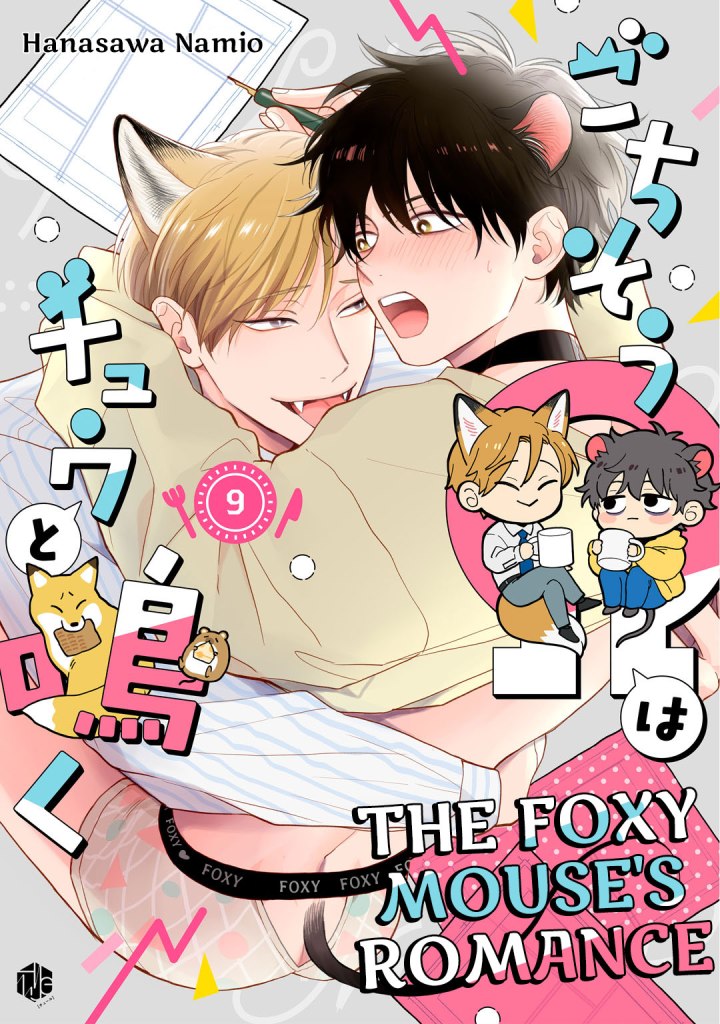
When our campaign team decided to hold a fan-letter campaign in honor of HANASAWA NAMIO’s “The Foxy Mouse’s Romance”, I read it to find out more—and then I threw a curse on my colleague that’s been blessed with preparing it for our website, because damn, do I wish I had his luck.
Writing this review to introduce more and more people to the sheer beauty that is this manga, I’m seriously struggling. There are just no words to describe how perfect it is. All I can think to write is an endless string of squealing. It’s that good.
Omegaverse meets the Food Chain
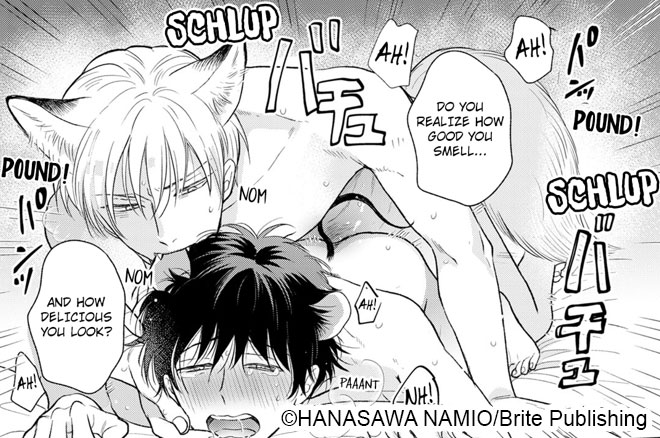
For the uninitiated, ‘omegaverse’ revolves around the idea of a ‘secondary genre’—omega, alpha, beta—based on as-of-now debunked animal behaviors around mating. Betas are the ordinary majority; alphas are bold, aggressive and at the apex of social hierarchy, while the rare omegas suffer through a phenomenon called ‘heat’ that causes them to exude pheromones that make them sexually irresistible to alphas.
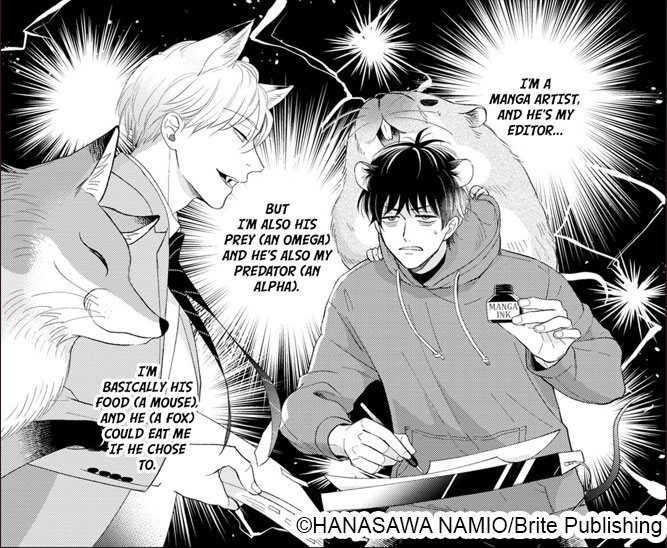
Now, throw humans originating from various animal species that retain predatorial/prey dynamics into that mix and you’ve got HANASAWA-sensei’s “The Foxy Mouse’s Romance.”
It follows the story of Sachio, a mouse omega working as a manga artist in a young men’s magazine, and Ukano, a fox alpha and his editor. The dangers implicit in a mouse omega and a fox alpha having to work together are not lost on either of them, especially Sachio who’s painfully conscious of his place in the bottom of the social ladder—and the food chain. Not only is he a sexual target for the alphas around him, but also actual food for predators—especially to Ukano, as mice constitute a fox’s main meal.
But, while Sachio may have his guard up against his editor, Ukano seems unyieldingly determined to pursue Sachio for love rather than for his stomach.
But first, let’s rant about that world-building
I cannot—cannot—overstate that it’s HANASAWA NAMIO-sensei’s world that stole my heart above all else. There are elements familiar to any reader of omegaverse (pheromone blockers, neck guards, secondary-gender clinics, the concepts of a ‘heat’ and a ‘rut’, etc.) but sensei’s animal-kingdom spin on it elevates everything to a different level.
Laws govern peoples’ animalistic, voracious tendencies. Omega-only spaces offer a safe night out. When someone is in their animal form, humans can understand their words only if their own animal ears are out—and, there are even little cards that state, “I have my ears out because I’m looking after someone, thank you for your understanding” to be worn in public in such cases. Grooming salons cater to one’s animal-form fur. Cab drivers must state their species and secondary gender on an ID card for the safety of their passengers. Diseases and phenomena surrounding the animal families or one’s secondary gender also exist, as do various intricacies surrounding sex between predator and prey.
All of it is proof that this universe exists beyond our two characters. HANASAWA-sensei could easily write other stories featuring this same world; and, on this point, the characters that surround our two protagonists are interesting on their own, too. The treacherous civet could have an extra tidbit, Sachio’s two mangaka friends, Tomo and Momoi, could have their own side-stories; I’m personally intrigued by the head editor of the publishing house.
That’s the beauty of this world; every detail that jumps out of the pages amuses and intrigues, and every panel serves the purpose of delving deeper into it all. Which also brings me to the matter of the art—besides being GORGEOUS, it’s also masterfully used to the utmost to tell this story. The paneling is on point. The expressions are fantastic as it is, but it’s the attention to detail that makes this world and the characters come alive, such as Ukano’s eyes dilating when he gets turned on. Anytime Sachio is hand-held in mouse form, you can almost feel the weight of his tiny, pudgy body in your own palm. The art accompanies the writing and dialogue perfectly, which is what makes this world so believable and the characters so relatable and easy to understand.
From (natural) enemies to lovers
Have you ever tried to sleep, only to end up staring at the ceiling with bloodshot eyes, wondering why the Hell you said x-y-z that one time? Then you’re bound to somewhat relate to our mouse protagonist. Who hasn’t wallowed in negativity at least once?
Though cynical at first glance, Sachio’s core is kindness. Despite a traumatic situation with his college friend Tomo, Sachio had always been willing to forgive him. Similarly, he comes to love Ukano, so even when a dire misunderstanding occurs in ch.4, Sachio is ready not only to forgive him, but also to get closer to him. His negative mind twists everything to take others’ mistakes onto himself, not just because he’s self-deprecating to a fault, but also due to his love for others.
Now is the part where I will do my best to describe Ukano without rambling incomprehensibly. I’ve written in other posts that dark stories and vaguely yandere characters are my forte, and, let me tell you, Ukano strikes a perfect balance between being a normal, loving boyfriend but also having this menacing, darker side to him. His loving devotion to Sachio doesn’t override his ‘foxiness’. The art itself often reminds us of his more devious nature via a grey shadow over his eyes. Sachio, at the start, is constantly on his toes around him, and we see that even others get an uncanny feeling from the wily fox.
But, it’s when we see Ukano’s perspective that we get, in my biased opinion, some of the greatest gems in this story. In a scene that explores what it’s like being a predator in this world, Ukano recalls a time that Sachio, too exhausted to keep his guard up, transformed into a mouse in front of him. Ukano transports him home in a bed made of his handkerchief (so. cute.) and that’s when we get this beautiful internal monologue: “Life is sacred, and I was holding someone’s whole life in my hands. That’s how humbled I felt. At the same time… I thought about how I could crush him easily if I wanted to. The sadist in me reared its ugly head. ‘I want to eat him.’ ‘I want to protect him.’”
Compare this to the time that Tomo surrendered to his wolfish instincts and you’ll see how Ukano shines: he’s deeply aware of his nature, but he understands it’s in his own hand to curb his urges. Just like a quote from a certain anime I love goes, “Taking responsibility for oneself is the basic qualification for being human” and truer words have not been spoken when it comes to this universe of beings teetering between human and animal. The line that divides the two is exactly this capacity for taking responsibility, and Ukano’s always on top of that. Contrariwise, when Tomo and Sachio reunite for the first time, Tomo literally runs away from his responsibilities, forcing Sachio to shoulder the blame for everything instead. Ukano could and would never.
Darkness, more darkness, and fluff
Whether or not I realized it at first, perhaps the thing that personally drew me to this story is that it hits that perfect sweet spot between tooth-rotting sweetness and grim darkness. The art is adorable, the interactions hilarious, the romance is great and the love between our two characters is true, but it all coexists with the bleak implications of an omegaverse world and the danger that one could lose control and literally eat their loved one. And, perhaps the best/realest thing about it is that those dangers don’t magically disappear after Sachio and Ukano become a couple; even if it’s through humor, the reader is constantly reminded of that possibility, just as Sachio and Ukano themselves are.
From the first few pages, the manga doesn’t pull any punches. Starting with a kid-friendly show explaining animal families and secondary genders in a squeaky-clean manner, the story soon contradicts this cheaply manufactured narrative with Sachio’s mother calling to tell him that his mouse omega sister got fired from her part-time job for getting into heat in front of an alpha customer and almost getting assaulted/eaten. Our mouse protagonist himself works as a mangaka because it allows him to stay cooped up at home (mostly), away from danger. And the story continues with various examples of how perilous, inconvenient, and downright unfair it is to be born as a mouse and as an omega.
Nowhere does it get more obvious than in the juxtaposition between our two main characters, not just in their obvious difference in status, but also in their thinking. When Ukano stands up for Sachio and the latter thanks him, Ukano thinks anyone would have done the same, but Sachio corrects him that no one would. ‘Foxiness’ aside, Ukano’s mindset is positive, proactive, that of someone who’s strong and therefore able to act for others without weighing any consequences first; Sachio, on the other hand, has had no other choice but to see the world—and his place in it—in the most negative light, existing as literal prey.
Due to his trauma and negative worldview, Sachio takes the blame and compromises on everything, out of love and the idea that it’s his justifiable place to act that way. While that mindset might seem odd to a lot of readers, it makes sense for Sachio as a character to think so, and it’s very pleasingly contrasted with Ukano’s worldview. “The onus is on me as an alpha.” he tells Tomo, his most direct foil in the narrative. While Sachio surrenders to the possibility that he could be devoured at any given moment (and it would be his fault, according to him), Ukano actively takes steps to ensure that he’d never hurt the one he loves, to embrace that danger and then boldly defy it.
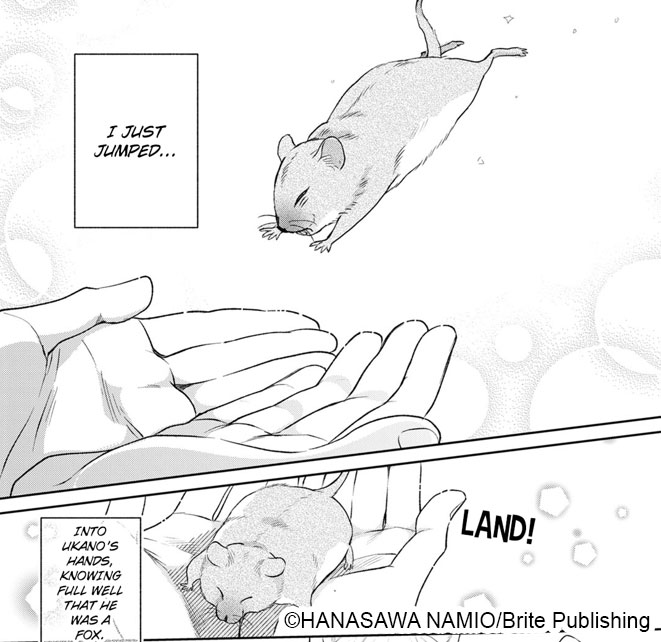
At this point it’s rather obvious that I’m rambling, but I can’t help it because there’s so much I could say about “The Foxy Mouse’s Romance”, even going into every single scene I adore (the horrible misunderstanding in ch.4? The jump in ch.5? the hand-holding heavy with implications in ch.7?? The fur-grooming session in ch.8???). If you enjoy elaborate worlds and multifaceted characters, if you fancy a dose of angst in your fluff, if you love stories about (dangers aside) wholesome couples, please give “The Foxy Mouse’s Romance” a chance. And, while we’re at it, why not show HANASAWA NAMIO-sensei your love through Renta!’s fan-letter campaign? All you need to do is either fill in the form here or tweet using the hashtag #SqueaksForSensei. I’m deliberating on sending something too (after I find out a way to convey my admiration in fewer words than this long blog post).
If you’ve read “The Foxy Mouse’s Romance”, what do you love most about it? What are your thoughts? Favorite character? Join me in rambling about it in the comments!
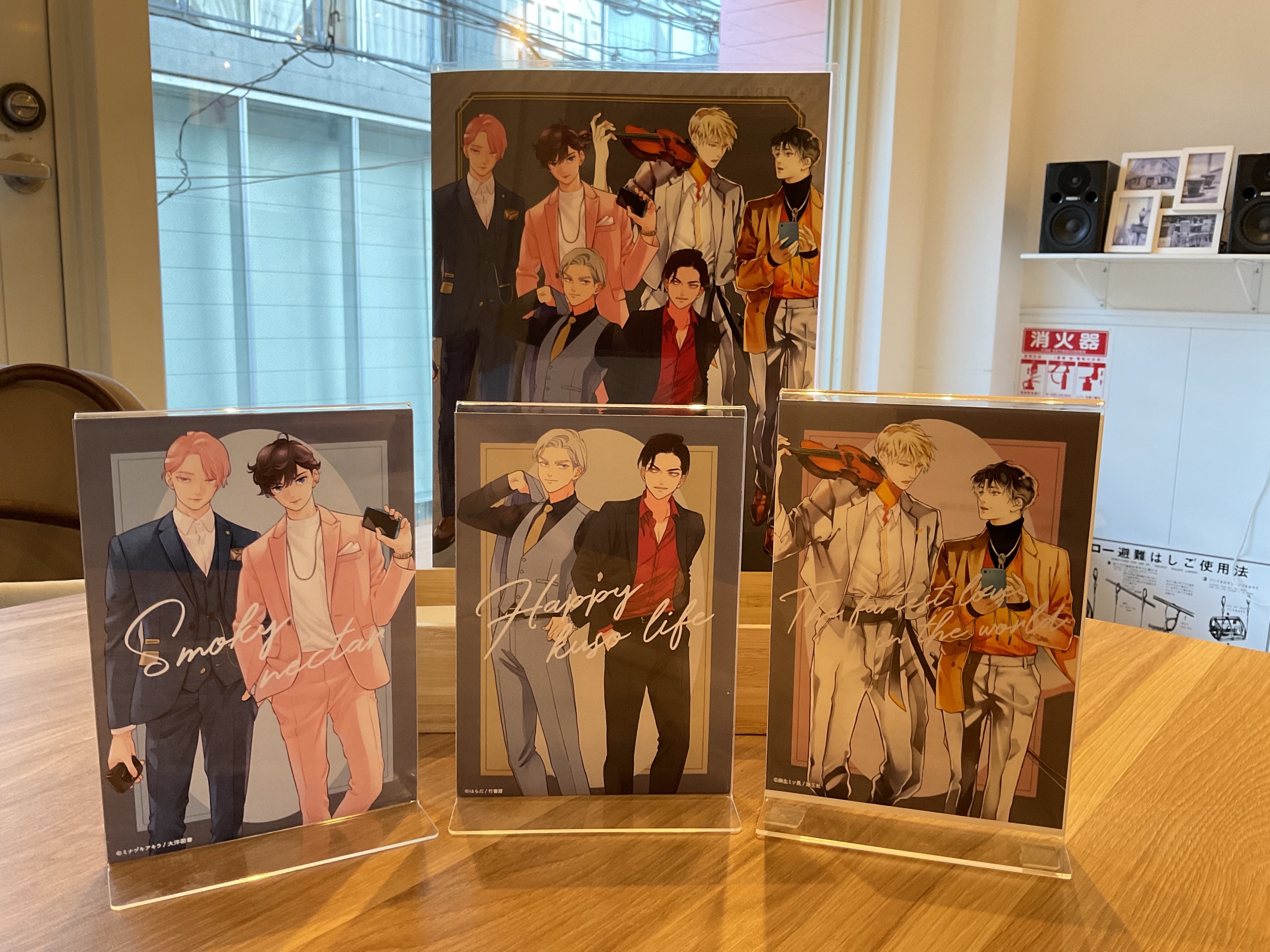
Nestled in a narrow, trendy side street in Tokyo’s youth fashion district of Harajuku is a bright pink building named emo café, a tiny collab café that partners with mangaka and publishers to turn manga into a culinary experience. emo café is relatively new, having started up in the last few years, and follows in the footsteps of other BL cafés like Toriko Mangaten and ComiComi Studio Machida (r.i.p.).
When I saw they would be doing a third B+Library, this time for Harada’s Happy Shitty Life, Akira Minazuki’s Smoky Nectar, and Mitsuaki Asou’s The Farthest Love in the World I knew we had to go—especially considering Happy Shitty Life is one of our localizations, and Smoky Nectar is coming soon. Unfortunately, because of the massive popularity of all three artists (each one of them being a veteran in the BL genre) I once again couldn’t get in.
…That is, until they extended the end date by a week. Sometimes it pays to sit on Twitter constantly. -w-)b
When I was suddenly asked in late May to attend AX as a representative of Renta!, I wasn’t sure what to expect. The last American anime convention I attended was in the early 2000s, and in Iowa, which is quite a ways from Los Angeles. I remembered being younger and hearing all the fanfare, seeing all my online friends from Cali attending, and dreaming that someday I’d be going to such a huge con—little old me, from the midwestern United States. And now here I was, being made that offer, from my office in Japan.
I’d never been to such a huge convention—even in Japan I’ve never been to Comiket, instead opting to attend the smaller events scattered through the year like HaruComi and Comic City. I wasn’t sure what to expect. Granted, I would also be attending as an industry insider rather than a fan, which is also a very different experience.
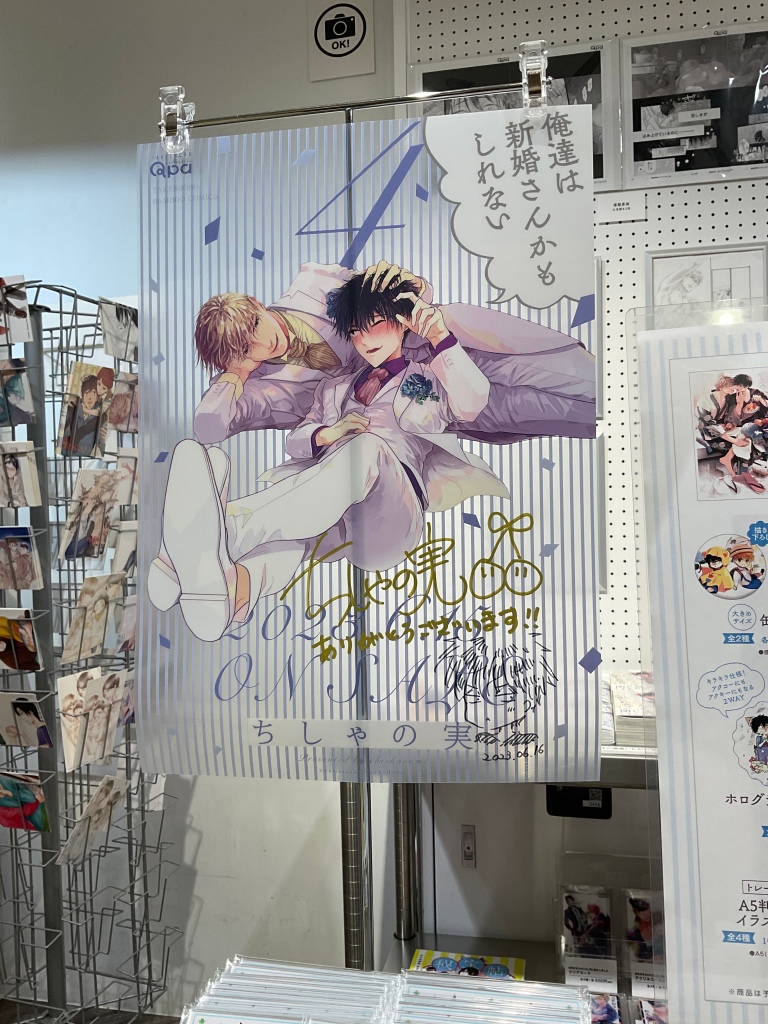
Event poster with a special autograph and Yukari doodle by Chishanomi-sensei
As a BL fan, it always delights me to see my favorite creators get some much-deserved recognition in public spaces — be it a collab cafe, a book signing, or a special art gallery. I love to visit these spaces when I can to show my support for the hardworking and passionate artists and their works which I admire so much (and get some cute exclusive merch while I’m at it)!
We at Renta!BLog are lucky enough to live in Japan and work in Tokyo, where BL gets its fair share of special events — so we thought, why not share this fun piece of fan culture with the world?
One artist who’s making waves in the BL community right now is Chishanomi, with the release of volume 4 of their hit series Maybe We’re Newlyweds (Japanese title Oretachi ha Shinkon san kamo shirenai). To celebrate its release, along with the 10-year anniversary of Chishanomi’s debut as a mangaka, a special event, including a manga art exhibition and pop-up store, dedicated to the series is being held at Manga10 in Shibuya’s Magnet department store. (It’s also being held in Taiwan, which just goes to show how much international renown Chishanomi-sensei has gained over their 10-year career!)
Ames and I recently had the opportunity to hit the bustling streets of Shibuya and check out this limited-time exhibition. Read on for our otaku heart-pounding experience!
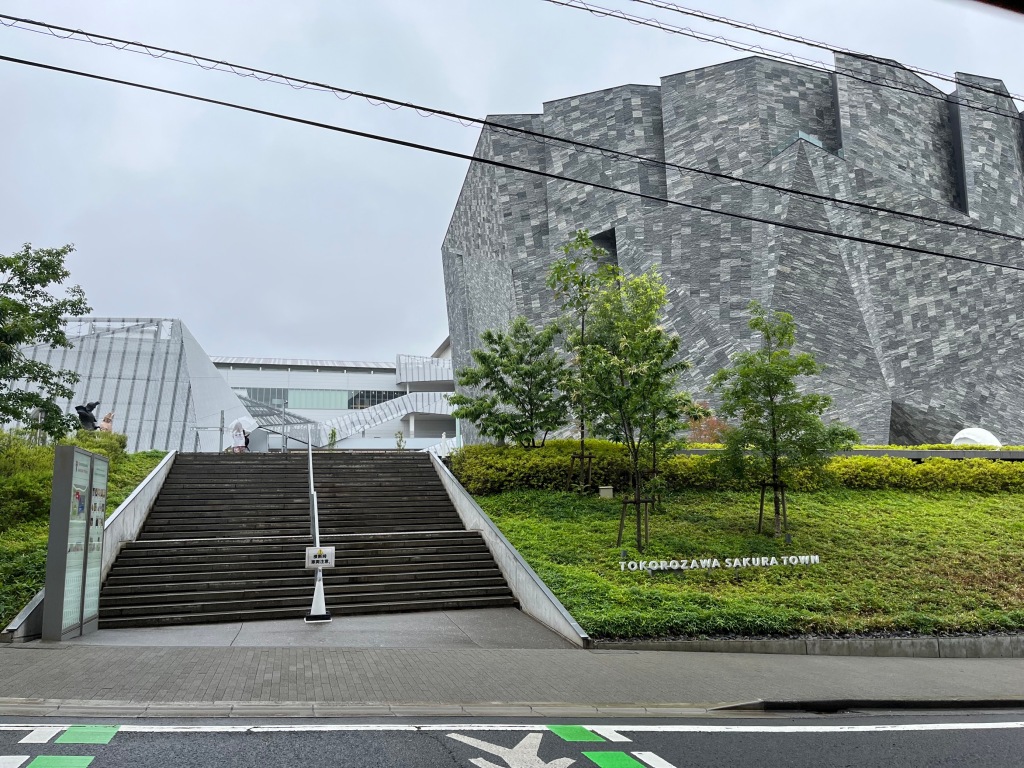
To delve deeper into the history and evolution of BL, the Kadokawa Culture Museum in Saitama is hosting a well-curated exhibition, titled, “BL Evolution: From Pioneers to Global Phenomenon ―Tracing the 50 Year History and Impact of Boys’ Love through Manga, Literature, and Media”. Sou and I decided to brave the one-hour train ride from the Renta! office, to give you a detailed report on what’s up.
The museum, established by the publisher Kadokawa, permanently hosts the Manga and Light Novel Library on its first floor, as well as the impressive Bookshelf Theater on the fourth. Rainy day be damned, the modern shrine on the museum grounds was also worth a visit, especially to get a good-luck charm for keeping deadlines (surely, an invaluable must-have for every mangaka).
The exhibition divides the evolution of BL as a genre into three eras. Numbered hearts with arrows piercing through them point visitors each step of the route, and famous voice actor Toshiyuki Morikawa narrates parts of it in his mellifluous voice.
First comes the ‘June’ era. ‘June’ was a women’s magazine founded in 1978, which focused on stories of male-male romance. It fostered many BL authors who basically pioneered the depiction of homosexual love in manga, preceded in literature by the books of Mari Mori. A timeline of BL publications, anime productions, visual novels, drama CDs, etc. adorns a huge wall, tracing the long history of BL. Across from it, a glass case protects old ‘June’ magazines with covers by BL trailblazer Keiko Takemiya, manuscripts, drama CDs, and even albums by David Bowie or books by Herman Hesse, as a collection of not only artifacts from the history of BL, but also of the manifold media that influenced the genre in its infancy.
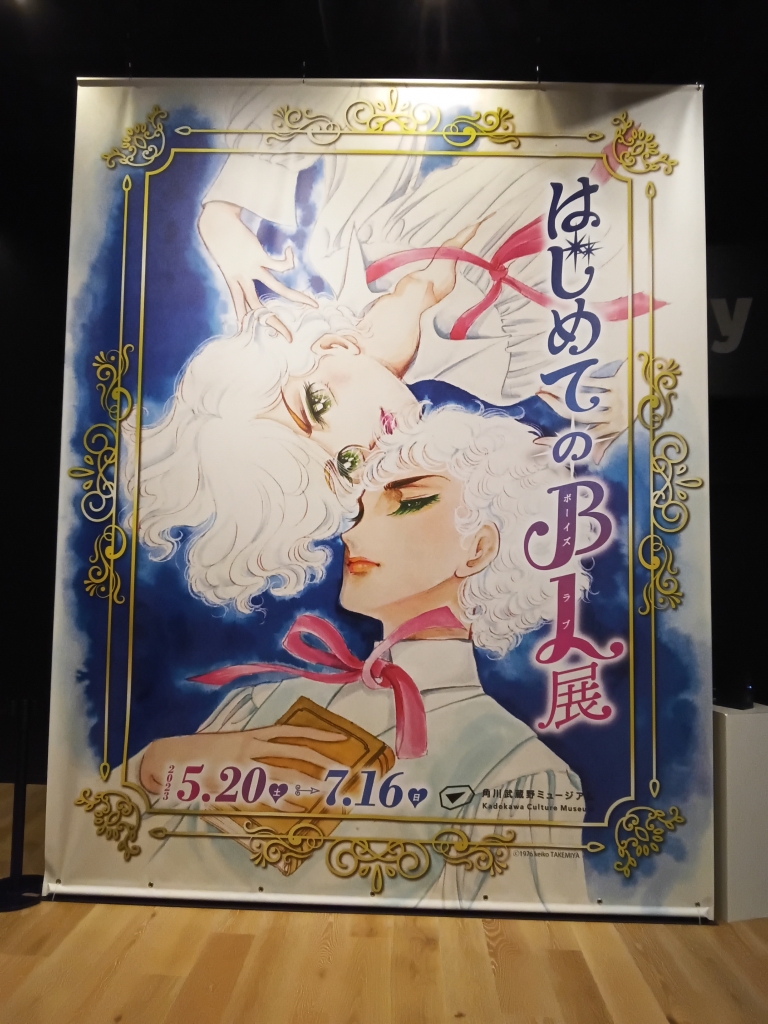
Speaking of the great Takemiya-sensei, her gorgeous art serves as the exhibition’s key visual. The exhibition also displays parts of her project Genga’(Dash), which is dedicated to the reproduction of original manga manuscripts. It is led by her, in collaboration with the International Manga Research Center of Kyoto Seika University and the Kyoto International Manga Museum (worth a visit, by the way!). Not gonna lie, seeing manuscripts from the ‘70s, reinvigorated in such a way, made my manga-loving heart giddy right off the bat.
And we were only starting. The exhibition then explains the ‘Yaoi era’. Most BL fans might already be aware, but a refresher never hurts: ‘yaoi’ is an acronym for the phrase “Yama nashi, Ochi nashi, Imi nashi”, a.k.a. “no climax, no punch line, no meaning”. Essentially, it came to refer to manga fanfics (doujinshi), created just for the pleasure of creating itself, without a care for plot, development, art quality, and so on. The first usage of the term is said to be in a doujinshi published in 1979, followed then by the ‘yaoi boom’ of the later 1980s, characterized by the birth of “coupling”/”shipping” of male characters in major shonen manga. Apparently, the first manga to facilitate such a rise in shipping doujinshi was Captain Tsubasa, which the exhibition highlights through maps of Comiket throughout the years (Comic Market = Japan’s biggest convention which caters to doujinshi artists and fans alike), increasingly more and more overcome by Captain Tsubasa doujin artists. This section included everything that I love: a culture of independent artists creating for the fun of it, and shonen manga. Couldn’t ask for much more.
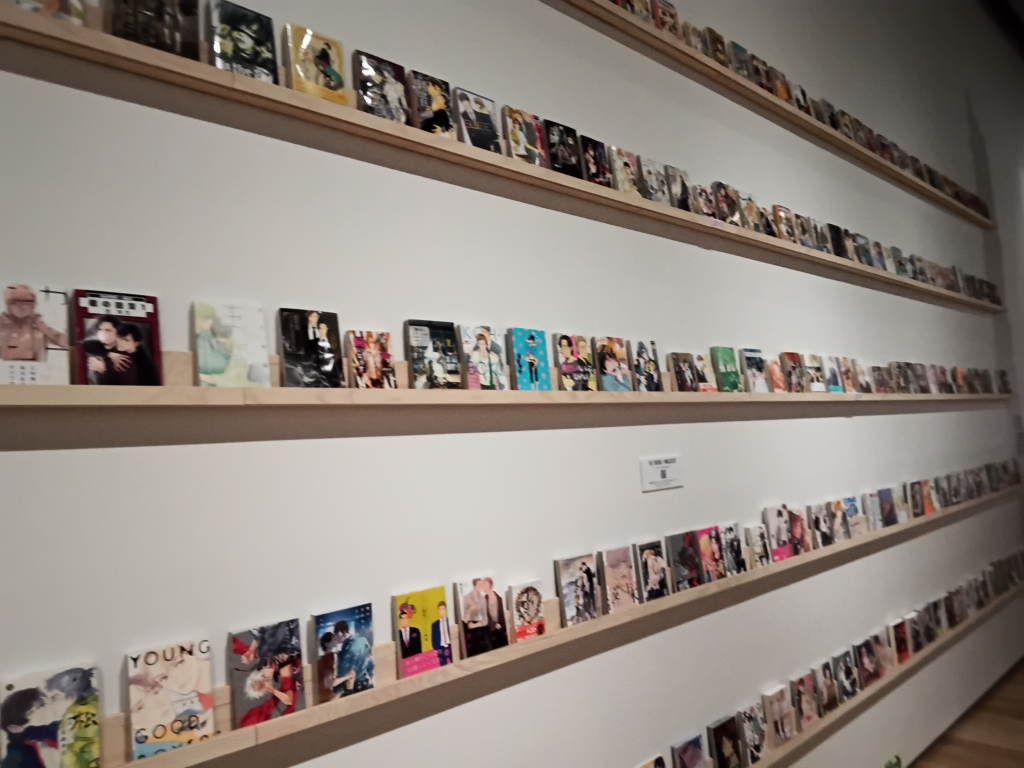
Subsequently, as yaoi culture expanded from Japan to the rest of the world, so did BL culture as a whole. That’s what the third and last section, ‘Blooming BL culture’ focuses on. From the early 1990s, BL manga and novel magazines were launched one after another, Kadokawa established its Ruby Bunko label for aesthetic BL novels, and more and more authors active in both BL and non-BL works made their debut. The exhibition also features examples of just how far broad the reach of BL has become, expanding into a transmedia franchise that’s recognized and followed by people all over the world (otherwise, Renta! and this blog wouldn’t exist!). In this finishing part of the exhibition, there are even posters and trailers of the movie adaptation of the manga “BL Metamorphosis”, about a young girl and old woman forging an unlikely friendship through their shared appreciation for BL. There’s also a huge wall displaying various BL (such as Tamekou-sensei’s ‘Lala’s Married Life’, Nagisa-sensei’s Kabukicho Bad Trip, Sorai-sensei’s Our Not-So-Lonely Planet Travel Guide), in a display of just how big and diverse the genre has evolved to be!
For anyone interested in visiting the exhibition, it’s on from May 20th to July 16th at the Kadokawa Culture Museum, in Saitama. The nearest station is Higashitokorozawa, accessible through the Musashino line. It’s definitely worth the train ride, even through the early June rain!









 rentaBLog