When I was lucky enough to attend the ChillChill BL 2024 Awards Ceremony and meet up with the head of Futekiya, they told me their coworker often attends little business seminars put on by ChillChill. This was the first time I’d heard of such a thing—business seminars specifically catered to people looking to spread the gospel of BL manga? Sign me up!
These seminars, aptly titled Fujoshi Marketing Kenkyuujo (or “Fujoshi Marketing Lab”), are run by SANDIAS, a BL marketing research firm associated with ChillChill. SANDIAS’s aim is to understand fujoshi and BL culture, and as such, they host seiyuu events, assist with the BL Awards, and help push other types of content (oshikatsu, idols, etc.) that might appeal to fans within that realm. The seminars can be watched via their YouTube channel as well. I highly recommend them if you can understand Japanese—they’re honestly fascinating, especially if you’re the type of dork who loves to look at the figures behind the things you love. Also, since ChillChill is one of the most well-known BL sites and is trusted and beloved by the BL community, it’s a bit easier for them to get interesting and varied stats from their surveys.
That being said, I wasn’t able to attend one until earlier this month, which we definitely had to set aside time for: Foreign Fans and Japanese BL Manga. ChillChill surveyed over 600 BL fans, half of which were English-speaking (EN) and the other half Chinese-speaking (CN), both from a multitude of different countries, and asked questions about their tastes and interests in BL, as well as their reading and spending habits. Originally, I wasn’t going to write a BLog post about it, but there was some information presented that I found really interesting, so I wanted to share that with our readers.
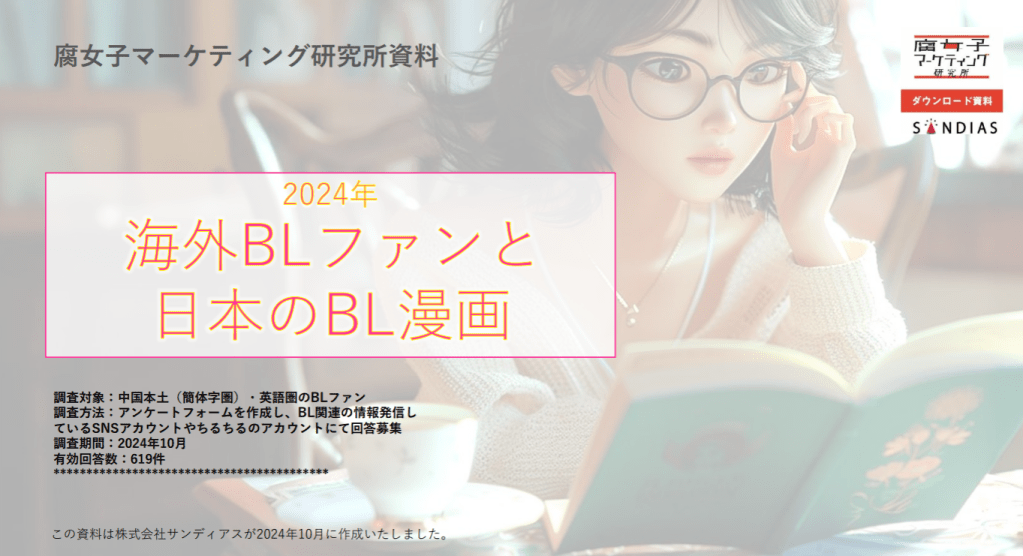
I’ll only be sharing a few of the slides to make my points, since I want to make sure ChillChill and SANDIAS get all the proper credit for their work. However, you can actually request the full presentation on their downloads page for free, along with previous seminar materials. For those who want to see all the data, please make sure to check that out! One video for the presentation is linked above, but be sure to check in on their YouTube channel regularly (and maybe even drop a sub) in case they continue to post content from this seminar as well as other interesting content in the future.
Also, I’ll mostly be focusing on the English-speaking side, since that’s the majority of our audience, as well as the community I have actual experience with.
The three seminar themes:
・How foreign fans are introduced to BL
・Foreign fans’ taste and trends
・Foreign fans’ spending habits
As for the fans who answered, they were most often in their 20~30s with 30~40s not too far behind. Interestingly, older CN fans were comparatively rare, with the vast majority of them being pre-30s. Another difference between EN and CN fans was that an incredible amount of EN fans have been into BL for more than 10 years—meaning, as the host pointed out, quite a lot of fans initially got into BL when they were still in elementary and early middle school. (I mean, same…) Supposedly, this isn’t too different from Japan, where a lot of people are initially introduced to the idea of shipping pretty early on.
They also asked how many of their respondents are open about being into BL. A vast majority of both EN and CN fans said they’re open with close friends or in fandom via social media (like Twitter—which had a massive lead for “Where do you get your BL news?”), with “family” lagging quite a ways behind. The host noted it’s actually quite common in Japan for BL fans to accidentally be found out by their family, which may be the case globally. He also noted that it seems EN fans generally prefer to be more open about their love for BL—however, of those who cited having never told anyone they like BL, EN was double CN, with many claiming they would be open if they had friends with similar interests.
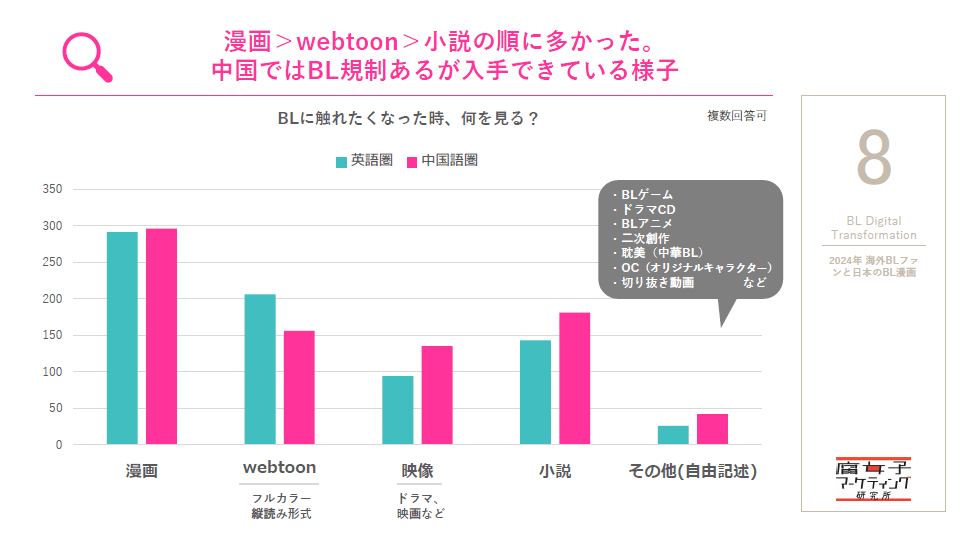
As far the actual BL content, traditional manga was unsurprisingly on top, but—particularly for EN fans—webtoons (as in, vertical scrolling comics, not to be mistaken for the actual Webtoon website) were a fairly close second. For CN fans, novels seemed a bit more popular. This part of the presentation surprised me overall, since I usually associate English fandom more heavily with shipping rather than with commercial BL, but 二次創作 (nijisousaku) or parody/ship (which would include content like fanfiction, doujinshi, etc.) was incredibly low. Perhaps this being a survey of people who actively use ChillChill skewed the results a bit, or perhaps commercial BL manga is (thankfully) becoming much more popular than it used to be, or maybe western fans separate the idea of fandom ships and “BL” more clearly.
Another thing that really seemed to differ between Western and Eastern fans is ship dynamics. As I’ve mentioned in the past in posts like Japanese for Nerds—in which I explain the various phrases for ship ordering—ship dynamics are incredibly important to the vast majority of fandom in Japan. While there are zasshoku (check out my post to find the meaning 🥴) who’d gladly take any ship with any dynamic and/or ordering, the standard is having a strict preference for who tops and bottoms, and sticking with it. People want the top and bottom to match their preferences, and it’s treated as a sincerely important part of the shipping puzzle.

In Western fandom, while I don’t want to say this isn’t the case entirely, being okay with the opposite ship (in Genshin Impact terms, being okay with both haikaveh AND kavehtham) as well as both characters being switches is a lot more common—and this showed in the data. EN responses were less than 2/3 of CN for caring about the seme/uke dynamic. Instead, EN users cared a lot more about art, worldbuilding, and who the author is. The host also acknowledged this, noting how it’s possibly because Western fandom ties BL (both as a genre as well as in readership) a lot more strongly to LGBTQ+ culture rather than a fantasy genre as it’s seen in JP/CN.
The next big difference between EN and CN audiences was that CN audiences were surprisingly more likely to be reading Japanese BL, with a vast majority of their current reads being Japanese titles. EN users, on the other hand, were more varied in their current reading list—with Korean comics coming in a relatively close second. CN fans were five times more likely to be reading Japanese BL, whereas EN fans were not even twice as likely. The series 19 Days by Old Xian came in second for series EN respondents are currently reading.
The final part of the seminar that I thought was worth sharing, which has been a massive topic in the BL localization field (and just generally in the localization and licensing realm), is what style of manga readers these days prefer: traditional (版面/hanmen, or black and white comics that’re read page-by-page) or webtoon-style (タテコミ/tatekomi, or VertiComix as Renta! refers to them, which are generally full-color and read via scrolling). In the manga industry, with the boom of sites like Webtoon and Lezhin, there’s been a major push to release VertiComix content, even by adapting traditional manga into vertical scrolling. So it was really interesting to see a lot of people still really enjoy—if not outright prefer—the black and white, page-by-page style.
Though I’m sure this may be a bit skewed by this being a ChillChill poll, since most overseas users who use ChillChill probably use it because they like Japanese-style manga. This is also acknowledged in the concluding statements: “while tateyomi (webtoon-style full-color scrolling comics) may be easier to access for a general audience, BL otaku still find enjoyment in reading traditional style manga.”
After that was a bunch of questions about purchasing behaviors, which is probably less interesting to regular readers than for those of us who work in the industry. So, I’ll just say that the conclusion for the section was: there are lots and lots and lots of overseas BL fans out there who’re interested in buying goods relating to BL, so it’s a market deserving of time and attention!
Anyway, I’ll definitely be continuing to go to these seminars. I probably won’t write about them—this was a special case, since it was about overseas fans, and I wanted to introduce the concept and YouTube channel to those who might be interested. Thankfully, in both JP and EN, there are a lot of great, interesting places to read about both the financial and sociopolitical impact of BL and its fanbase (see also: our “LGBTQ Issues and the Globalization of ‘BL’” conference report) for nerds like me to stay on top of everything that’s happening with the content I love. 🤗

 rentaBLog
One thought on “We Attended the ChillChill Fujoshi Seminar!”