From Japan’s やおい論争 (Yaoi Ronso, or Yaoi Debates) to the online discourse of today, the most common question surrounding BL in media and social criticism is “what is BL’s place in the larger sphere of LGBTQ media?” Does it belong there at all? Is it a genre that, while revolving around MLM, remains entirely separate from LGBTQ culture? Does it mostly being written by and for (supposedly) straight cis women fully disengage it from being LGBTQ? Is BL a force for good, or does it only exist to promote stereotypes of queer men? And what about BL’s treatment of women? Which supersedes the other: the queer men who’re uncomfortable with the content in some BL, or the fans who use BL as a reprieve from the stifling nature of the heteronormative media landscape? Or is BL, in itself, heteronormative?
Those are just a handful of the questions discussed at the Meiji University symposium “BLの国際的な広がりと名国のLGBTQ,” or “LGBTQ Issues and the Globalization of ‘BL’.” Hosted by around twenty scholars, academics, fans, and community members from around the world, this symposium aimed to share research around how global queer communities interact with and shape BL in their own image post-import.

First, a little background. Taking place on November 25th and 26th, the event was hosted at Meiji University, which is often at the forefront of manga studies and research in Japan. The actual lectures were held at the Nakano campus, which just seemed right considering Nakano is also home to Nakano Broadway, a huge multi-level otaku hub for used manga, doujinshi, and goods. It’s been years since I was personally on a university campus and, being a huge nerd (I probably would have tried for my graduate degree if I hadn’t landed my dream job), I was pretty excited to feel those academic vibes again. Especially since the temps recently finally took a turn in Tokyo, so not only was it academic vibes, but cold weather, fall leaves, grab-a-huge-ass-coffee-before-class vibes. The perfect atmosphere to nerd out about BL manga for two days straight. (And get paid for it… 😏 I love my job.)
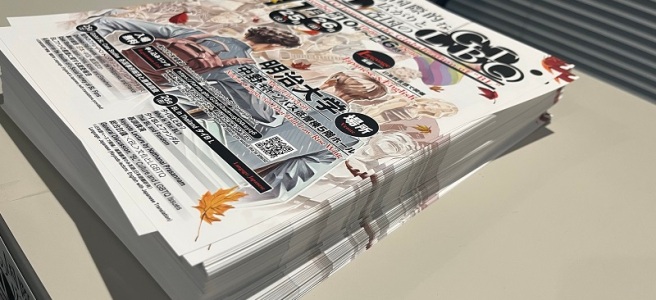
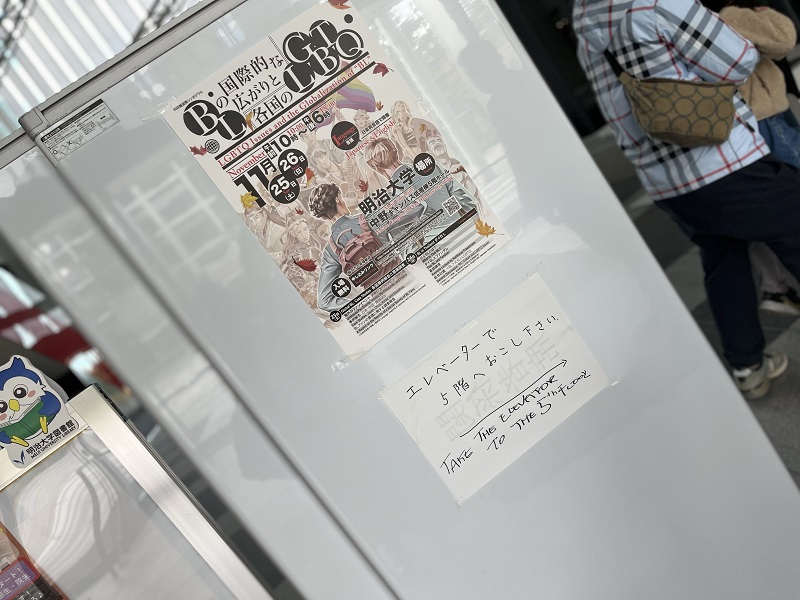
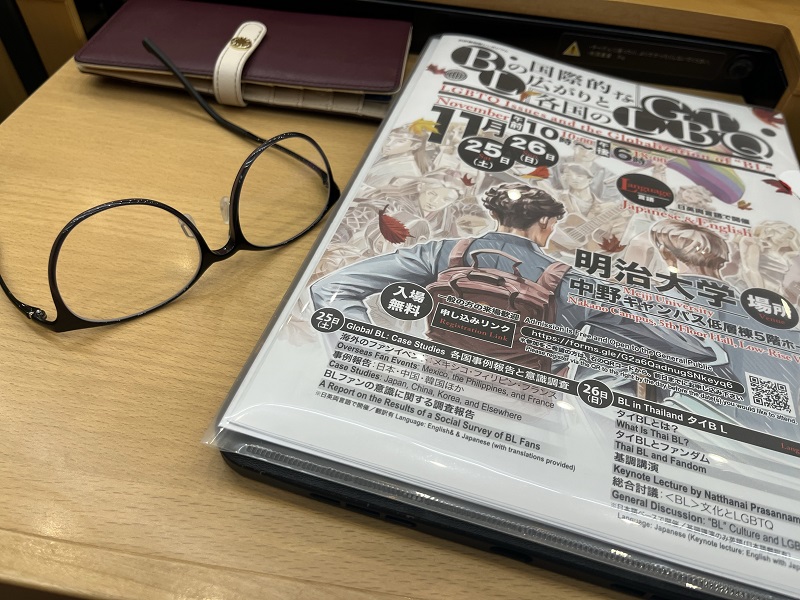
The campus was easy to find, as was the lecture hall, which is admittedly a bit of a rarity when it comes to Japanese events—finding the right location for events in Tokyo often feels like a maze of long walkways and wrong entrances. But everything was very clearly marked beforehand and day-of. All we had to do was go into the campus and up the elevator, where they had campus employees handing out the flyer with the schedule, as well as all the supplementary data we’d be asked to reference.
As for the actual event, it took place in a relatively intimate (and extremely toasty… 🥵) lecture hall. The hosts and lecturers sat in the audience down by the front, and were extremely accessible for any audience members who wanted to chat or ask them questions during down periods. We were asked to not go directly for row seats, since they were expecting over 300 people each day, and people would probably continue to trickle in as the day progressed. For the privacy and safety of everyone in attendance, we were also asked to not take any photos, videos, or recordings—which was a bit of a shame only because there was SO much information I couldn’t get it all down (and some pretty funny jokes and slides I’d have loved to have saved to laugh about later whenever I happened across them again in my phone), but definitely understandable considering the content of the lectures. We were also all asked to turn off our phones to prevent interrupting the presentations.
(Cultural tip for those who want to come to Japan: it’s generally considered poor manners to openly share the faces of non-consenting people online, especially on a large scale. This is why you might often see Japanese people putting stickers over or censoring the backgrounds of “public” photos they share online.)
Day one was fully bilingual. When lectures were held in Japanese there was a screen with an English translation, and vice versa. The staff were very careful to make sure an interpreter (mostly Julie Debelhoir, who was also a presenter) translated everything so speakers of each language could understand. It was very enjoyable, however, being able to understand both languages as there were some jokes and cultural references that didn’t translate well between Japanese and English as well as some super long, funny tangents that only got a quick summary in translation. The subject for the day was “Global BL: Case Studies.”
Day two, titled “BL in Thailand,” was entirely about Thai BL and its surrounding culture and fandom, and was mostly in Japanese with the only exception being the English keynote lecture and a handful of Thai during the Q&A (which was carefully translated into Japanese by cultural critic and presenter Artch Bunnag). A small side tangent, but one thing I really appreciated on this day was that, after Sou and I arrived, Professor James Welker came up and—not assuming we knew English just based off the fact that we clearly aren’t Japanese—informed us there was a Japanese transcript at the front if we needed it.
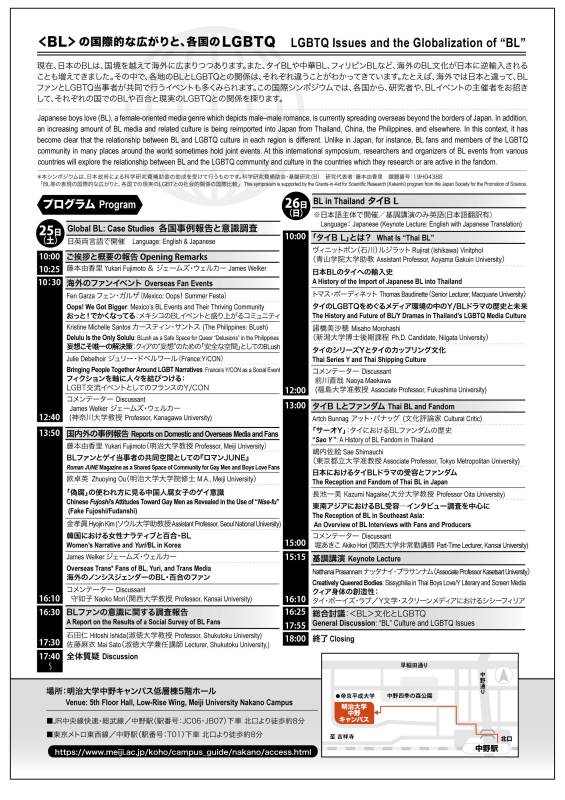
As for the actual schedule for the lectures, taken from Meiji’s website (please visit their site for the full-size versions!):
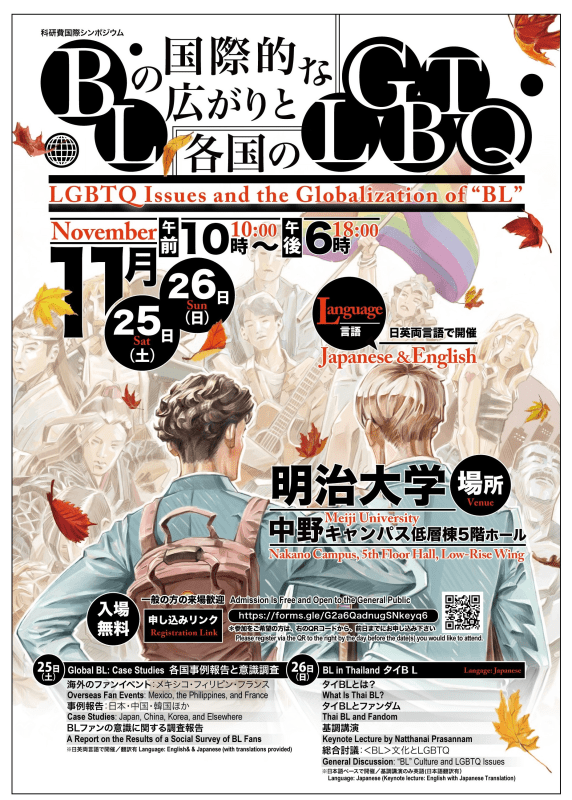
Isn’t the flyer lovely? I actually pilfered three of them just to make sure I had one to turn in for work, one for research purposes during the process of writing this report, and one to keep at home.
I hate to have to condense everything down so much, since it was two days of incredibly dense (and fascinating) information for which I have more than 19 pages of notes, but I’ll do my best to link all the presenters in the post so you can check out their research for yourselves.
Also, I think this is a good time to include a disclaimer: because of the nature of reporting on and condensing this research, I’m taking this information out of the larger context of the actual books, essays, presentations, etc. from which it originated. This report is my take-away from what was presented. What’s most important is going and checking the research by each individual yourself, since I’m not going to be able to provide the full picture of years and years of research in a small paragraph or two. 😔
Day 1: Global BL: Case Studies
====================
First Half: Overseas Fan Events
Opening Remarks
Yukari Fujimoto (Site | Wiki | Twitter)
James Welker (Site | Twitter)
Oops! We got bigger: Mexico’s BL events and Their Thriving Community
Fen Garza (Oops FB)
Delulu Is the Only Solulu: BLush as a Safe Space for Queer “Delusions” in the Philippines
Kristine “Khursten” Michelle Santos (Site | Twitter)
Bringing People Together Around LGBT Narratives: France’s Y/CON as a Social Event
Julie Debelhoir (Site | Twitter)
Closing Remarks
James Welker
Second Half: Reports on Domestic and Overseas Media & Fans
Roman JUNE Magazine as a Shared Space of Community for Gay Men and Boys Love Fans
Yukari Fujimoto
Chinese Fujoshi’s Attitudes Toward Gay Men as Revealed in the Use of “Nise-fu” (Fake Fujoshi/Fudanshi)
Zhuoying Ou
Women’s Narrative and Yuri/BL in Korea
Hyojin Kim (Site | Twitter)
Overseas Trans* Fans of BL, Yuri, and Trans Media
James Welker
Closing Remarks
Naoko Mori (Site)
A Report on the Results of a Social Survey of BL Fans
Hitoshi Ishida (Site)
Mai Sato (Site)
Discussion
====================
In the opening statements for Day 1, Yukari Fujimoto outlined why this symposium was happening in the first place: in her travels to research BL, she saw that many cultures around the world see BL and queer culture as intrinsically linked, whereas in Japan—referred to frequently as “The Birthplace of BL”—BL and queer culture are seen as wholly separate. Wondering why this might be the case, she wanted to provide a place to share global perspectives on BL and its many communities, from the Americas to Europe to all around Asia.
The first half of day one revolved around fan events in Mexico, France, and the Philippines. Even though the three locations are incredibly different, the story was essentially the same: fans of BL, desperate for a safe space to enjoy the content they love, create an event to foster community and physical space to be themselves and openly love what they love. Over time, this community also becomes a safe harbor for LGBTQ fans to be unabashedly queer in a place that accepts them. Mexico’s “Oops” went from a small celebration around a BL doujin circle into a full-fledged LGBTQ art convention, giving a voice to LGBTQ people who’re otherwise being silenced. The Philippines BL convention “BLush” smartly hides its queerness under ambiguous branding to create a safe space for people to not only simply enjoy their favorite male/male ships, but also to be in a place—if even for just a day—where queerness can be celebrated and accepted. As for France? We learned that while French bookstores tend to shun literature written by and for queer authors as “too niche,” through the popularity of manga in France, BL and GL are a way for non-heterosexual stories to be widely shared and spread during times of political and social unease. France’s Y/CON—the “Y” standing for “Yaoi,” “Yuri,” and “You”—gives a space to share stories that buck the norm, from more traditional queer coming-out stories to bizarre fantasy omegaverse.
All three of these talks really made me realize the importance of a space to feel safe unabashedly being yourself and enjoying the things you love. As the internet evolves into web 2.0 and beyond, many of those tight-knit community spaces have become tainted and unsafe, or have been taken away altogether. When asked the question of why in-person spaces continue to be important even when we have whole online communities at our fingertips, the answer was unanimous—humans, as we saw very clearly during the pandemic, thrive most when they’re in the physical presence of other people they feel safe and open around. We are social creatures who crave connection. Conventions and other community spaces often become safe zones where fans of this content—straight or queer, cis or trans or non-binary—can be openly themselves without the shame and fear they usually face in daily life for both their interests and their identity.
The second half was a bit more of a wild ride, dealing more heavily with cultures I’ve never personally come into contact with: Japan’s early BL community of the late 80s and early 90s, China’s online community during the danmei boom of the late 00s and early 10s, and Korea’s online “Leaving BL” radical feminist movement. Yukari Fujimoto’s presentation was an eye-opening look into the connections Japanese fujoshi and queer men used to have through a single publication titled Roman JUNE, and showed that the hard separation between LGBTQ and BL hasn’t actually always been a thing in Japan. The lecture on China’s “fake fujoshi” was an interesting look at how online communities police themselves to reject certain behaviors and mindsets. As for Korea, we learned about radical feminists and their rejection of BL as inherently misogynistic—as they claim it has no “women’s narrative” by proxy of being exclusively about male characters while also normalizing sexual violence—and their embrace of GL as inherently moral… before realizing GL also relies heavily on many tropes they find problematic (women who are always beautiful and young and romance-focused, etc.).
James Welker’s discussion focused on overseas trans and non-binary fans, sharing the results of a survey in which he asked how people felt their identity was linked to their consumption of BL, GL, and other Japanese queer media. This was born from Welker noticing the fact that BL communities often have many people who are openly trans and non-binary relating to characters who are most often cis. The responses were very eye-opening and sometimes extremely relatable, from some saying they didn’t connect their identity to the media they consume at all, to others giving very personal and vulnerable answers about BL being a safe-haven from the highly gendered relationships they see in other media, or how they appreciate BL characters fitting a whole spectrum of different versions of masculinity.
Day one ended with a report on a social survey taken by Hitoshi Ishida and Mai Sato. Gay men and then women were surveyed separately, with those results then broken into BL fans and non-fans to see their understanding of BL and LGBTQ issues within the two groups. Does being a BL fan make women more open and understanding regarding LGBTQ issues? Do gay men still feel negatively about the existence of BL? Those were some of the answers being sought.
I obviously can’t share all the results, even though they were fascinating. The results were most essentially that being a BL fan DOES actually appear to make its female fans more open to LGBTQ issues (if only slightly), but that the vast majority of BL fans in Japan still prefer to see BL as fantastical rather than inherently connected to the realities of the LGBTQ community. As for the survey of gay men, it appeared gay men who have actually read BL feel a lot more favorably toward it than those who haven’t (this was also a spectrum by age, with men 39 and under being much more likely to consume BL than those 40 and above), and while the majority of men surveyed do think BL should at least kind of reflect the realities of gay men, those surveyed were completely split on whether or not BL should be allowed to be seen and treated as fantasy.
During the discussion, Sato stated that doing this research made her, as a BL fan in her personal life (though her research isn’t BL-focused), recognize that she also separates BL and LGBTQ issues in her head, which was an uncomfortable realization. Another interesting key point brought forward by Ishida was that—while it’s obviously necessary to consider the valid reasons gay men may take issue with BL—it’s important to note that most who do haven’t actually read much of it, if any, and that we also can’t take these issues out of a larger and highly misogynous society where even gay men may well hate the genre less because of its content, and more that it’s seen as by and for women.
And with that very heavy thought, day one came to a close and Sou and I were left to get pancakes and parse the incredible amounts of information we spent the last eight hours taking in.
Day 2: BL in Thailand
====================
First Half: What is “Thai BL”
Opening Remarks
Hitoshi Ishida
The History of the Import of Japanese BL into Thailand
Rujirat (Ishikawa) Vinitphol “Gift-sensei” (Site | Twitter)
The History and Future of BL/Y Dramas in Thailand’s LGBTQ Media Culture
Thomas Baudinette (Site | Twitter)
Thai Series Y and Thai Shipping Culture
Misaho Morohashi
Closing Remarks
Naoya Maekawa (Site)
Second Half: Thai BL and Fandom
“Sao Y”: A History of BL Fandom in Thailand
Artch Bunnag (Insta)
The Reception and Fandom of Thai BL in Japan
Sae Shimauchi (Site | Twitter)
The Reception of BL in Southeast Asia: An Overview of BL Interviews with Fans and Producers
Kazumi Nagaike (Site)
Closing Remarks
Akiko Hori (Site)
Keynote Lecture:
Creatively queered bodies: Sissyphilia in Thai boys love/Y Literary and Screen Media Natthanai Prasannam (Site)
Closing Discussion
====================
Day two was fully about Thai BL and (almost) fully in Japanese, with no English translations. Neither Sou nor I knew much at all about Thai BL going in—for me, my only brush with it was loosely following some people on Twitter who like it, and also reading the Japanese manga version of The Red Thread, which is based off a Thai Y novel-turned-drama. I admittedly stick pretty closely to Japanese BL, since I’m traumatized from my otaku youth when there was just so much Japanese BL I wanted to read that wasn’t getting translated into English and I just… couldn’t… and I don’t want to relive that in every other language I don’t know. So the information in the day two presentations was all new to me.
Needless to say, on a fan level I came away really wishing I could dip my toes into the vast sea of Thai BL (I want to read… “Ai, You Are So Fluffy”…). On a sociology nerd level, I have a much stronger understanding of Thailand in regards to sexuality and fan culture.
The first half of the day was dedicated to explaining the history of Thai BL and its fandom on a surface level, whereas the second half was dedicated to digging a bit deeper into individual topics. I must say, you could tell many of the presenters were fans of Thai BL just as much as they were academics, because their enthusiasm for the subject was incredibly infectious. During the opening remarks, Hitoshi Ishida asked everyone to raise their hands if they were a fan of Thai BL—and a shocking two thirds or so of the audience raised their hands. I was definitely in the minority as a total Thai BL noob; at one point the women in front of us were even trading cards of Thai Y drama actors.
I was particularly struck by how different Y drama culture around shipping actors is compared to Japan. As I outlined at length in my post about namamono, the culture around shipping RPF and RPS in Japan is very hush-hush in order to not make the actors uncomfortable, so to find that these actor pairings from the Y dramas are actually pushed by the media companies was shocking. It sounded like the actors from these dramas live very hectic, stressful lives—and I wasn’t the only one concerned about that, since someone asked what can be done to decrease their workload during the Q&A.
One thing I found really interesting is that the exported Thai BL is seen as a legitimate form of soft power, even by the Thai government. With the explosion in popularity of Thai BL titles around the world, particularly in Japan (and especially during the pandemic), it’s seen as an opportunity to export Thai culture around the globe. While BL originated in Japan, after it hit Thailand and mingled with Thai culture, it transformed into its own media.
Also, it was interesting seeing how the inclusion of LGBTQ narratives and creators found a way to share queer stories while also upholding tropes. In Natthanai Prasannam’s keynote lecture, he pointed out the ways Y dramas morph and change as they come in contact with queer narratives, but some BL tropes are left. Maybe a story is all about a katoey top who’s ultra fem and cute and flamboyant, but the BL trope that’s kept is the height difference or body type. Seeing the evolution of BL as it touches the lives and absorbs the experiences of people around the globe was definitely a treat as a BL fan.
Also from Natthanai Prasannam’s lecture, I really appreciated the discussion of what he referred to as “sissyphobia” even within gay spheres, or an overt rejection of the feminine among gay men. Using the example of an actor and performer named PP, who seamlessly moves between feminine and masculine forms of expression while always being wholly himself, however, Prasannam showed how this proliferation of Y dramas and the waifish actors who take the “bottom” role in them allows a space in the wider landscape to give birth to new ideas of queer identity.
Overall, Thailand was a fascinating look at how BL, once imported, takes on the identity of the new audience and culture and slowly evolves. As Gift-sensei said in her opening presentation, manga entered Thailand in the 60s and today has grown into a Thai culture of its very own.
Finally, we wrapped up with a short Q&A on Thai BL before moving on to the closing remarks of both the day one and day two presenters. One final statement I really enjoyed is that we have to be careful when talking about BL around the world to not make statements like “all Thai BL is like ____” and “all Japanese BL is like ___” because there are multitudes of different authors with different experiences and different beliefs in all cultures and they’re all contributing to the genre. You can find Japanese BL that takes place in New York and is incredibly LGBTQ-centered, and you can find BL about beautiful Japanese schoolboys written in the U.S. Especially as BL continues to become more and more global, we’ll continue to see more and more stories shared that mix tropes from all around the world.
In closing, Thomas Baudinette brought it back to the question of whether or not BL is intrinsically homophobic by proxy of creating fantastical queer stories for a (supposedly) non-queer female audience. He said we have to be careful to not lean into the misogyny that often rears its head with criticism against women’s media. Building off that, in the final statement of the night, Naoya Maekawa took the mic and said it’s discriminatory in itself to push the idea that all gay men must dislike BL, and that out of all the people in this world who’ve been saved by reading the stories in BL, there are many men and many women (and of course many non-binary people), and that’s what matters most.
So, is BL a form of LGBTQ media? Well, that seems to depend heavily on who you’re asking. To some, both fans and antis alike, they prefer BL continue to be seen as its own thing on the periphery of LGBTQ stories. However, to others it can also function as a safe space: for women who’re struggling with the pressure inherent in their gender identity, for those questioning their gender or sexuality and want to heal their heart with stories of a queer utopia, and for gay men who enjoy the fantastical atmosphere of BL that romanticizes and normalizes queerness. Whether intentionally or not, BL and its communities often find themselves a safe and comfortable place to explore queerness, and it’s magical to get to hear those stories.
Overall, I’m incredibly glad I was able to attend “LGBTQ Issues and the Globalization of ‘BL’.” In a funny meta way, the conference itself felt like a safe space for the attendees to open ourselves to these questions without shame, and to actually question this genre we love and the impact it has on the people it touches. It made me love BL even more, even with all its silly tropes and weird quirks, and it was lovely to be in a room of other people who felt the same.
In closing, I would like to once again remind everyone to please check out the actual researchers through their academic and social media links I tried to share in this post. As I said before, in order to make sure I’m not putting word in their mouths or misrepresenting their research, this is only a surface-level interpretation of all the incredibly dense and fascinating information that was shared at the symposium. If anything in this tiny report interested you, I’m sure their full body of work will be significantly more fascinating.

 rentaBLog
6 thoughts on “BL and its place in LGBTQ media.”