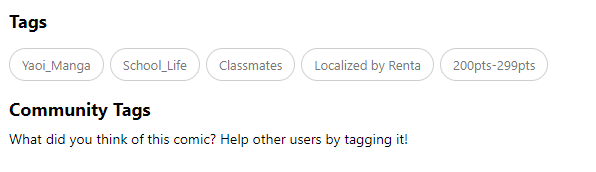
While searching on our site, you may have noticed we have two tagging systems:
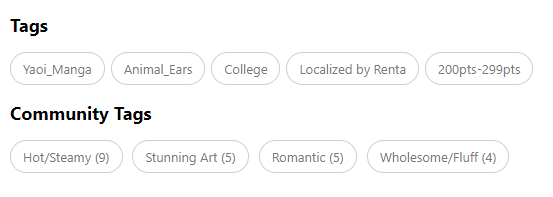
For those who’ve ever wondered why in the world we need two tagging systems, or what these two tagging systems are used for, I figured I’d do an explainer. I’ve noticed the community tags in particular seem under-utilized, and since they’re sincerely more helpful the more people actually use them, I was hoping I could “take a Selfish” and talk about why I think the community tags are important.
What are the two tagging systems?
Our first and longest-running tagging system is simply… “Tags.” Tags are pretty self-explanatory; they’re essentially there to help readers search for the type of manga they want to read. They include the pricing, so users can find deals or read stuff that’s in their price range, or also search for higher pricing if they only want to read tankoubon or compiled releases. These tags also include important “genre” descriptors of the manga itself, such as the larger genre (“Yaoi,” “Mature Romance,” etc.) and then the subgenres or categories (“Animal Ears,” “College,” “BDSM,” “Delinquents,” etc.—we have a lot of category tags, so please check them out by clicking on search).
Community tags, however, exist to highlight the actual content of the manga. They’re heavily based off tagging systems like ChillChill‘s (Japan’s #1 BL community site), where there’s a wealth of tags to describe the general vibe of the manga as well as the behaviors of and relationships between the characters.
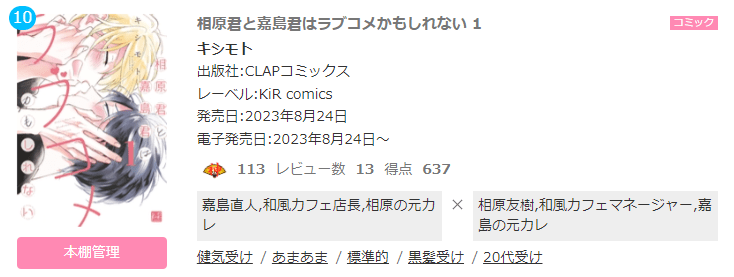
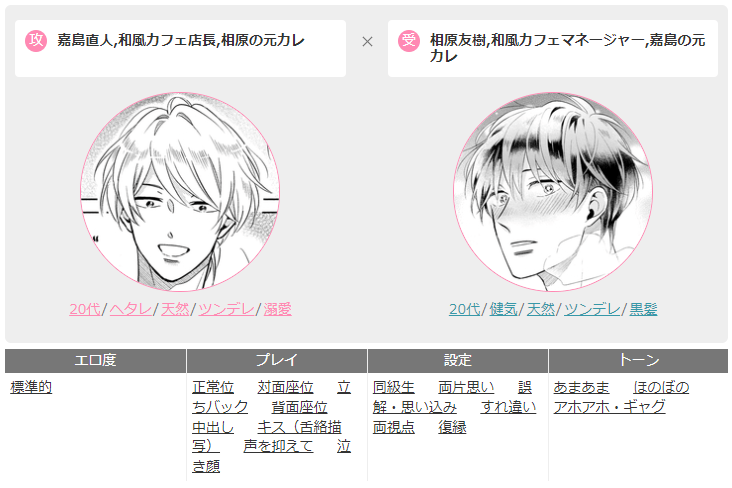
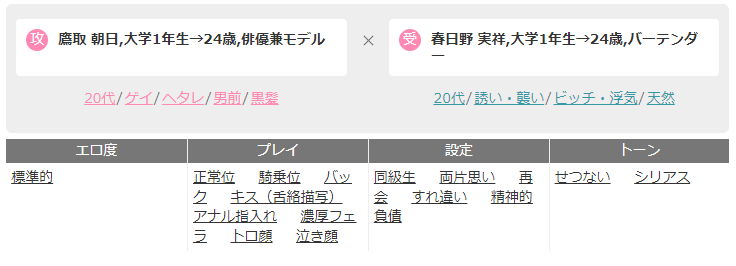
(The プレイ/fetish section isn’t visible unless you’re logged in, btw. But if you’re a huge fan of BL and regularly follow Japanese releases as well, I can’t recommend enough that you get well-acquainted with this site!)
As can be seen in the above examples, there are tags for エロ度/erodo or the level of ero (both examples simply read “standard” lol), the type of activities that take place during the ero scenes (referred to as プレイ or “play”), 設定/settei or tags that describe the setting and relationship between the characters (in the above examples, “reunion,” “unrequited love,” “misunderstandings,” “classmates,” etc.), and finally the トーン or tone of the manga itself. For A Romantic Comedy Between Two Ex-Boyfriends, which is a sweet, silly comedy about two guys in love who just can’t seem to properly convey their feelings, the tone is “sweet,” “heartwarming,” and “comedic.” For Intimate, But Not A Friend, however—which is a bittersweet, sexy slow-burn about two men who’ve been longing for each other since high school—the tags are “bittersweet” and “serious.”
Renta!’s community tags are supposed to capture a similar vibe to ChillChill’s “tone” tags, and offer the ability for our readers to understand the actual feeling of the content. Because if you just go by the category—a delinquent story, for instance— the tone can be vastly different—it can be incredibly sweet and silly and stupid, but it can also be incredibly violent and dark (it can be your angle or yuor devil, if you will).
But all of ChillChill’s tags are chosen and moderated by their site runners, and our community tags our chosen by our community. Why is that?
Why were community tags implemented?
We first started discussing the concept of community tags three years ago. We were receiving complaints about the need for tags or trigger warnings about content that was making readers uncomfortable, and needed to figure out how to convey what was actually inside the manga in order to prevent the wrong stories getting into the wrong hands. Plus, we needed to figure out a way to implement the feature without having to add too much work to our plates. Having the employees go in and add a content warning or tag, for instance, would be very time-intensive, especially with how much content was already on the site.
We could have the quality checkers add the tags or warnings during the check process, or the translators add them during translation. But then, what about content we receive from partners that we don’t personally review past a chapter or two? Plus, another issue with that is that everyone’s threshold for certain types of content is different. For instance, if I was named arbiter of the tags, my threshold for non-con content is VERY high from years and years (since I was, like… 11 years old??) of growing up reading tons of non-con and dub-con fanfiction. I’m not particularly phased by a lot of it, so something would likely get through under my watch that could be VERY uncomfortable to someone else. Similarly, someone else might read something they don’t think is particularly romantic or touching, but in the right hands a different person might think that manga is a masterpiece and might push all the right buttons.
Not to mention, as a product of the culture surrounding sex in Japan—and just because those kind of fantasies are actually quite common when women are given a safe space to explore them—dubious consent (or even full non-con) is incredibly common in romance stories, so it’s hard to know what our readers find “passable” for the genre or what’s straight-up unacceptable. It’s definitely a person-by-person situation.
So we figured the best way to do it is to let the community decide. We would provide the tags that we figured would be most helpful, and users can add the ones they find most appropriate. This tagging system was officially implemented halfway through 2021, but unfortunately there wasn’t much fanfare around it outside our usual Notices & Updates page, so those who actually saw the notice likely forgot quickly…
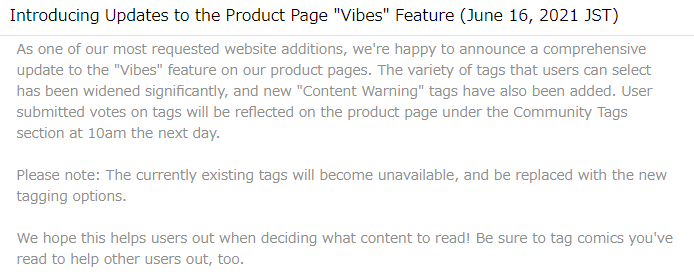
So I want to showcase them again. Community tags, or “vibes” as they’re also called, are incredibly easy to add and can be done directly from the product page:

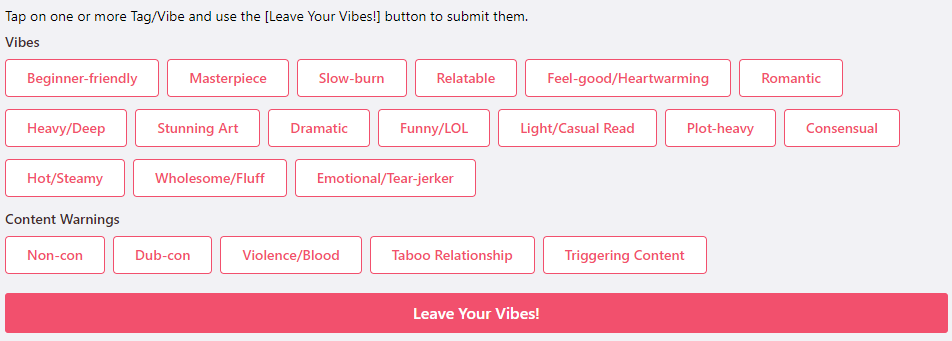
“How are they useful if you already said people will all feel differently about the same content?” you may be asking. Well, that’s why I say the tags are more useful the more people add them. For instance, if you can see thirty people added community tags, but only two said “non-con,” that means if you’re particularly sensitive to non-con that you should tread with caution, but if you’re not too bothered by it in most circumstances you’ll probably be okay. (This is why it’s also important to know yourself, your own preferences, and your own thresholds when it comes to media consumption! Safety first!) If all thirty people say “masterpiece,” then it’s safe to say it’s probably pretty great across the board. If only one in thirty said “masterpiece,” however… well, we can all be happy for that single person that they found something that’s right up their alley, but there’s a high possibility you might not feel quite so strongly.
For instance, in the above Chew Me Up And Teach Me About Love example, NINE people said it was hot/steamy, so that should be the biggest take-away. Five of those people said the art was stunning, so if only half really loved the art, it might be highly preference-based. Same with whether or not you’re going to find it romantic.
Another example, this time from Sakae Hiraku’s Reunited By Chance:
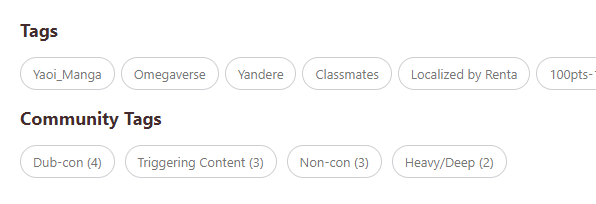
For this one, the biggest take-away should be that anyone who’s uncomfortable with dubious consent should steer clear—almost all the tags have to do with it being a dark, heavy, and potentially triggering read.
How about Coco Aino’s Intimate, But Not A Friend?
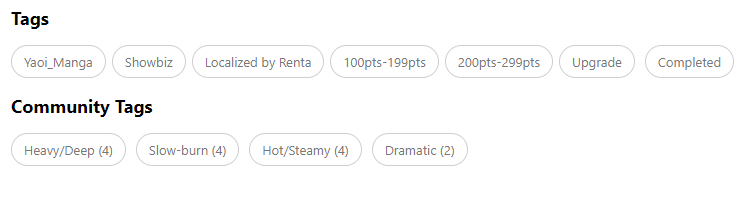
Most people seem to feel the same across the board: it’s a steamy, bittersweet slow-burn. You pretty much know exactly what you’re getting into when you read it.
Anyway, I hope I’ve made it clear why I think the community tags are a great resource, and why their usefulness goes up when people use them frequently. I think they can be used to paint a clear picture of what readers will get when they make their purchase, which is incredibly important. There’s nothing worse than buying a manga, and then feeling like you got duped into spending money on something that very much isn’t to your tastes. It happens to the best of us, but the more tools we have to avoid it, the better!
So, make sure to utilize the community tags whenever you have the time or wherewithal to do so! They’re a great way to have your voice heard on a manga’s content, and are incredibly helpful toward letting people know if a manga is something they’d want to read or not.

 rentaBLog
2 thoughts on “Community Tags, Why They Exist, and Why They Matter”