A lot of people who’re interested in anime and manga often think they’d like to work with it someday, but since localization is kind of a closed industry (understandably, since there’s a lot of IP that needs to stay hidden behind NDAs) there seems to be a lack of understanding for what goes into localizing, just how many different types of jobs there are, and what goes into taking a manga (or manhua or manhwa) from its original language and adapting it for an English-speaking audience. So I figured I’d take my personal experience in the manga localization industry and talk about that today!
What is Localization?
First off, what is localization? Simply put, localization is the process of adapting a translation to fit readers or viewers of a different culture. Literal translations can sometimes leave very large cultural concepts intact without explaining them or making them understandable to a foreign audience, and localization looks to solve that issue by making minor tweaks to the source material—editing a sentence to describe a food that was otherwise just named, changing the currency, changing a youth culture phrase in the source material to a similar style of speech, etc.—to make it easier to understand for readers who aren’t so acquainted with the source culture. I’ve lived in Japan four years and there are still cultural things that pop up in the manga that make me do a double-take, so localization is used to kind of explain or slightly alter certain cultural things that wouldn’t make sense otherwise.
There’s a big debate in otaku circles between which is better—to translate literally, or to localize the content. Some prefer literal translations because it’s a view into the source culture. For instance, you can learn a lot about Japanese culture by reading manga and watching anime—daily life, youth trends, cultural norms, etc. Some are also traumatized by old localizations changing simple things like onigiri (rice ball) to jelly donut, which are entirely different foods, and just feel a bit unnecessary to some.
Professional translation tends to favor localization, because it makes the translation easy to read for both hardcore fans and casual readers who don’t want to sit and look up every cultural reference they don’t understand. Also, not localizing certain things can similarly alter the intended content of a scene, i.e. if a phrase like tapiru—the slang verb for “to go get bubble tea”—is translated literally, it loses the youth slang cuteness, so if you don’t localize it at all to a cuter or more stylish phrasing, it falls flat.
In my opinion, a good localization does both: it keeps as much of the source material intact as possible, and only changes things that are necessary for fully understanding and enjoying the story—adding in cultural explanations without removing too much. However, the unfortunate fact is that in the process of even the best and most faithful translations or localizations, some nuances just can’t be translated. For instance, if a character speaks kansaiben, a dialect spoken in the Kansai region, it’s usually a marker of them being more outgoing, fun, laid-back, etc.— a personality type you often find in that area of Japan. But that gets lost as soon as you translate to English. You can give them a southern accent, as used to be the norm in many past localizations, but the nuance of a southern accent in the U.S. is different from the nuance of a Kansai accent in Japan. Working in this field is having to come to terms with the fact that some things just aren’t translatable without littering the page with a dissertation in translator notes (which takes away from the story in its own way).
The Process of Releasing English Manga
Some people may know certain aspects of the manga industry quite well after reading or watching series like Bakuman. There’s actually quite a wealth of manga about manga publishing, which makes sense—writers are often told to write what they know, and who knows the manga industry better than someone who works in it? Most manga about publishing end as soon as the manuscript is finished and handed off to the editor, however, and the truth is the manga industry goes a lot deeper than that—particularly once the manga is licensed for English release.
The story you may already know well goes like this: First, the mangaka brainstorms a story, often with the help and input of their editor. Once they’re given the okay, they (and possibly a team of assistants, depending on how famous they are) write a ネーム (rough outline) and then a 原稿 (genkou, or full manuscript) which then gets sent to the editor. The editing team puts any finishing touches on the manga. Before full publication, the cover is also planned and sent out for design, the mangaka is allowed to make any extra edits, and then the sales team works to distribute the full manga with their printers and book stores all around the country, not to mention the many digital distributors.
As you can see, that’s already a lot of people and work in the process of releasing a single story. But it gets even more convoluted once it’s chosen for an English release. I can only speak for Renta!, so I’ll explain our process here.
First, it starts with licensing. For some publishers, we have licensing contracts with them that make it easier to request titles. With other publishers, since we don’t have a contract with them, we have to formally request specific titles and make a case for why they should be given to us. For some publishers, it’s out of our hands because they have a contract with other localization companies, or have English subsidiaries and prefer to publish their own content. Relationships between us and the publishers are very important, since they’re the protective wall that ultimately decides if they’ll allow the localization or not. We almost never interact with the mangaka themselves.
As for how we find our manga? I try to keep an eye out for what’s currently selling really well Japan, as does our sales team. However, what’s popular in Japan isn’t always what western readers are most interested in reading, so our best way of knowing if a manga is popular is by following BL fan accounts or by our readers’ suggestions and requests. Both me and sales team track requests, so please feel free to keep them coming. (Though, as stated above, checking if it’s a publisher we usually release might be a sign of whether we can fulfill your request or not!)
Once we’ve gotten the green light, we’re given the data by the publisher. This is sorted onto the servers by our data team. After everything is in place, the project coordinator for the localization team then assigns and “orders” a translation from a freelance translator, and we send the raw Japanese files as well as data for the official “romanized” name of the publisher and mangaka.
After translation is complete, it’s then sent out to a freelance translation checker. All of the translators and checkers should be well-versed in our Style Guide, which is a set of rules and expectations we have for the translation quality. The checker goes over the translation to make sure it follows the Style Guide, is true to the Japanese, and reads naturally in English. It’s then sent back to us with feedback (important to keep improving our translation process and quality!), and we prepare it for lettering.
After lettering, the manga finally makes its way to the final wall: the in-house checkers. The in-house Renta! localization team currently has five checkers whose job it is to be highly-versed in the Style Guides—for translation and lettering, and we also have an Omegaverse Style Guide—and have a trained eye for what makes a localized manga look nice and read professionally. Edits are marked and requested, which are then sent back for a second round of lettering, and then the in-house checker can either accept the current quality, or make more edits in-house.
(The in-house checker might also edit the entire manga in-house if there are any particularly egregious errors, which happens sometimes when a translator is given a project with content that’s a bit too niche for them to have grasped some of the concepts and vocabulary.)
But it’s still not done, as it’s checked one last time by the maker of the 最終版 (saishuuban, or final files). This person (who’s actually our very own Sou) reads the manga with fresh eyes, as if viewing it as a customer would, and looks for mistakes that were somehow missed during all the other processes. After it’s been marked as finalized, it’s added to the release schedule by the data team, and the site coordinator adds it to the website.
So overall, the process of localization includes at least eleven people minimum, not including advertising, social media, if a new cover design is ordered, any people who added translation input or advice, etc. There are a lot of people working to get this manga into a language you can understand and a format you can read.
What’s it Like to Work at Renta!?
When I first started at Renta!, I was hired as an in-house checker. As was noted previously, the job of an in-house checker is to have the Style Guides memorized, understand Japanese enough to make sure the translation itself is correct, and be well-versed enough in Japanese AND western culture to be able to catch mistakes. Every localization team staff starts here, and is trained in attention to detail and quality control.
The Style Guide has already been touched on, and why our staff needs to have a high level of Japanese should be obvious (we’re also a fully Japanese company, which means all company, department, etc. meetings are conducted in Japanese). The one people might find surprising is that it’s important to keep our thumb on the pulse of popular culture in both Japan AND the west. This is because we need to be able to seamlessly move concepts between the two cultures. A clothing brand is name-dropped but it’s not a brand people outside Japan will know? The brand needs to be changed to something similar in cost and cultural context in the English. The store Don Quixote, for instance? Wal*mart vibes. (Of course, we can never name brands outright regardless, since we don’t want to get sued…)
Another example: Vtubers and streamers are supremely popular in Japan as of the last few years, and have been popping up in BL more and more recently (which I’ll write about at a later date), so a strong knowledge of pop culture trends is necessary. How can all the phrases and concepts for Vtubers be translated into English? For instance, 配信 (haishin) literally just means “broadcast,” so a translator might not realize that in this context, a literal translation doesn’t fit, and it needs to be localized to “livestream.” Vtuber is a concept that exists in both English and Japanese fandom, so you need to be well-acquainted with it enough to know to not change it to “virtual online performer” or something that sounds equally awkward. Thankfully, we have a team with many different niche interests and areas of expertise, so this is something we can usually avoid—but we still have questions and conversations around this kind of thing daily.
Knowing Japanese culture well is a given, but knowing how to match it to English culture without making the translation feel stilted is a true skill. Some may be surprised, but in the interview process for in-house staff, we even ask “how do you intend on keeping up with trends and slang in English while living and working in Japan?” (I, personally, watch a lot of YouTube and spend too much time on Twitter…)
Localization and the difference between the two cultures also comes into play during the licensing process, as there are some types of stories and media that are culturally acceptable here, but not so much in the west. For example, sexual content involving teenagers is quite commonplace in Japan. There’s a lot of discomfort in the west around romantic and sexual content involving teenagers, so while some of that media is incredibly popular here, we won’t license content dealing with any characters under the age of 15 or characters who even look young but never have a stated age. We have to be careful around certain kinks, and while incest, for instance, is very touchy in the west, it’s quite common in a genre like BL (taboo love, and all that) so we have to balance how our audience might react.
There are also manga that are just too difficult to localize. We currently hold the license for a manga titled Sa Shi Su Se So de Kudoitekuru Konamaiki Senpai, which is a cute story about a guy who works at a company who falls for his “sweet talking” coworker. However, this manga deals with the highly Japanese concept of Sa Shi Su Se So, a way of speaking that’s employed by Japanese women to make male coworkers or bigwigs feel superior that includes phrases like sasuga! (“As expected of someone like you!”), shiranakatta! (“I had no idea!”), sugoi! (“Amazing!”), sensu ii! (“That’s so smart!”), sou nanda! (“Is that so!?”), thus Sa Shi Su Se So (which follows the Japanese alphabet). Finding a way to translate this manga in a way that sounds natural in English without just littering it with cultural notes (something we avoid like the plague) has been unbelievably difficult, which is a shame since it’s an adorable manga and we’d be happy to show it to you all someday.
On a funnier note, there are definitely certain things about my particular localization job at Renta! that make it feel very unique. For one, we handle X-rated content for much of each day. Originally, during the days of peak pandemic, we used to work from home and have localization conversations in Teams work chat that would be easily considered sexual harassment elsewhere.
“Is ‘thigh fucking’ the right wording for sumata? Is ‘thigh fucking’ common enough in English? Is it referred to as something else?”
“What is ‘lotion gauze’?”
“What’s a good way to say someone’s ass is good and warmed up without calling it LOOSE? Loose sounds too rude but he said it’s yawarakai in the Japanese…”
“How do people feel about the word ‘fuckhole’? How about ‘bussy’?”
“Can you still say ‘jacking off’ if it’s a woman doing it?”
These are the kinds of conversations we have daily. (My Google search history is also, uh… quite spicy compared to most professions.)
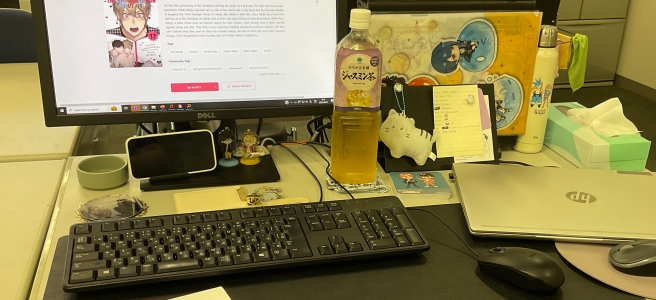
To make things worse (or better, depending on your sense of humor), we’ve returned to working full time from the office, and it’s an open office plan with no cubicles or sound barriers (as most Japanese companies are), so all the fellow members of our department (and sometimes from the whole company, if we’re rowdy enough) get to hear all of our debates on the best terminology for every single sex scene and kink under the sun.
Needless to say, it’s not a job for the faint of heart, or anyone who’s even vaguely prudish. We also ask during the interview process if the applicant is okay with sexual content, because they’ll be working on a lot of it.
One last unexpected side-effect of my job at Renta! is that it permeates my brain at all times. I feel like a lot of translators and editors can attest to this, but it’s almost impossible to turn it off once work is over. Whenever I’m reading BL in my off time, there’s a part of my brain that’s thinking about the best way to translate the dialogue. It’s unfortunately very difficult for me to read localizations by other companies as well—not because they’re bad by any means, but because I have what I like to call “Renta! brainrot,” by which I mean that my mind is so finely tuned to our specific Style Guide (each company has their own Style Guide or set of rules when it comes to translation and lettering) that when I see things that aren’t in line with our Style Guide, editor brain switches on and takes me out of the story. 😓 Womp womp…
But overall, I really love working in localization. It gives me an opportunity to handle lots and lots and lots of BL, and to share it with a huge audience of people. It’s also fun and challenging to think of great localizations, to discuss language with my coworkers, and constantly broaden my vocabulary when I learn something new.

 rentaBLog
2 thoughts on “What kind of job is localization?”